
How ultratrail running pushes your limits—physically, mentally, and in life
“Ultra runners are as different to marathoners as are sequoias to daffodils.” — Jared Beasley
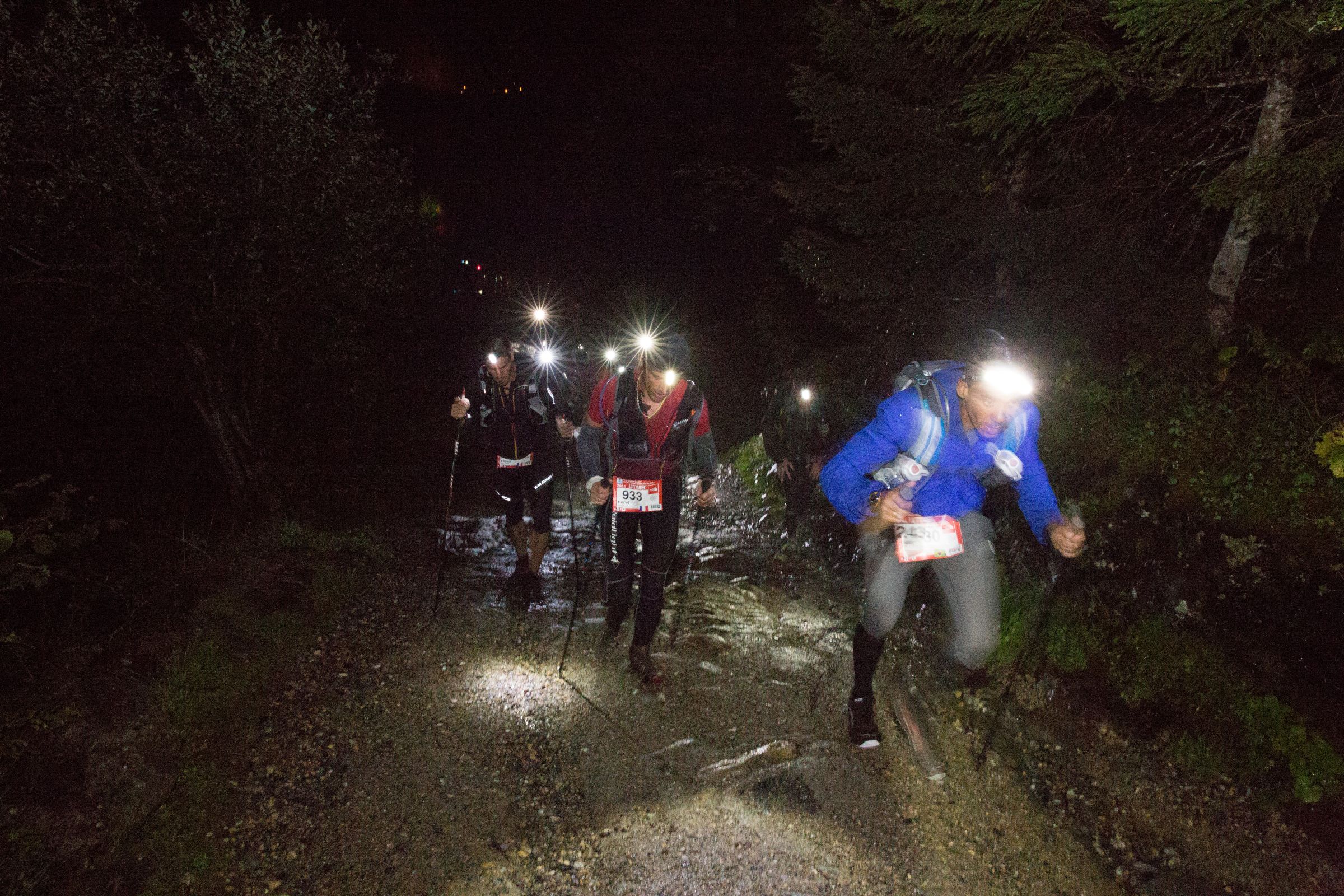
It’s nine o’clock at night. You’ve been running for more than ten hours. Your headlamp throws a narrow beam onto the mountain trail in front of you. You’re thirsty and hungry, your legs ache, and the next aid station is still more than an hour away. And yet, you feel a deep sense of contentment. You know you’re exactly where you want to be.
Ultra-trail races are among the most demanding forms of endurance performance there is. They cross mountains and forests, rivers, deserts and alpine paths — in heat, cold, rain, and darkness. They ask everything of you: physically, mentally, emotionally. Anyone who completes an ultra comes out of it changed.

Life Begins on the Other Side of Your Comfort Zone
Why do you do this to yourself?
Ultra runners hear this question often, from family, friends, colleagues. The answers vary, but one comes up regularly: because it demands the best version of yourself. An ultra isn’t a race against other people. It’s a dialogue with yourself.
Most of us live our daily lives inside a permanent comfort zone. We arrange things so that as little friction as possible arises. We make decisions in favour of convenience, and we avoid anything that might be strenuous, uncertain, or uncomfortable. But that habit comes at a price. It quietly erodes our resilience. Where there’s no friction, there’s no growth. People who always take the path of least resistance lose their capacity to deal with difficulty, they lose mental strength, and become more easily stressed out. Small problems feel huge, because the experience of having pushed through harder challenges is missing.
There’s also a kind of numbing effect. When things like entertainment, food, temperature, mobility are available and optimized all the time, our appreciation for what we have begins to fade. Contentment becomes fleeting, because it’s no longer felt in contrast to effort or discomfort.
Over time, this orientation toward comfort also narrows our horizon. We stay within familiar patterns, avoid risks, and miss opportunities for development, professionally and personally. Convenience becomes an invisible boundary that we rarely question.
That’s why experiences like an ultra-trail go so deep: they remind us that growth always happens on the other side of the comfort zone. They show us that we can endure more, achieve more, and create more than we would ever discover in the comfort of our daily life.
“Distance is whatever your mind makes of it.”
Finishing an ultra changes the way you see yourself. Someone who has completed a 100-K trail race deals with everyday pressure differently afterward — with more calm and more perspective. Because once you’ve kept moving through the night, exhausted to the core, waded through freezing rivers and climbed on legs that wanted to stop hours ago, you come out the other side knowing something most people never discover: how far you’re truly capable of going.
The months of preparation leave their mark too. You learn to prepare systematically for different scenarios, you learn to improvise and adapt your strategy on the fly. Add to that the experience of being out in nature, and the unique community of like-minded athletes around the world.
The Training: 8–12 Months of Consistent Build
One important note: if you’re aiming at an ultra, you should already have a marathon under your belt. The marathon shows you what a sustained endurance effort actually feels like and it gives you the physiological foundation that ultra training builds on.
An ultra-trail race deserves up to 12 months of careful preparation. The foundation is a clearly structured training plan, with the majority of the work done in Zone 2.
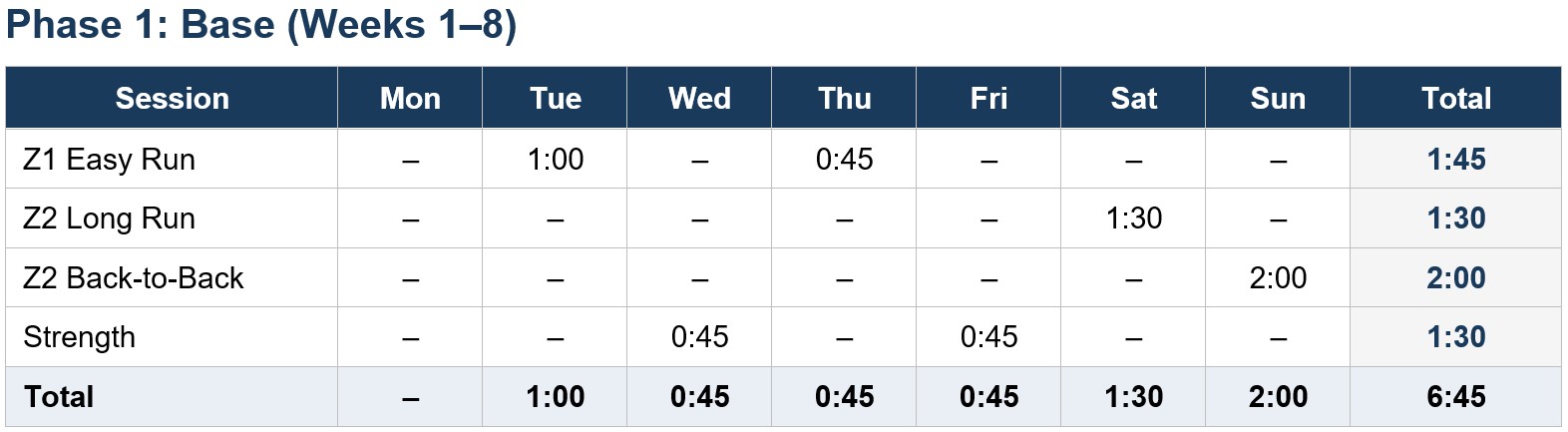
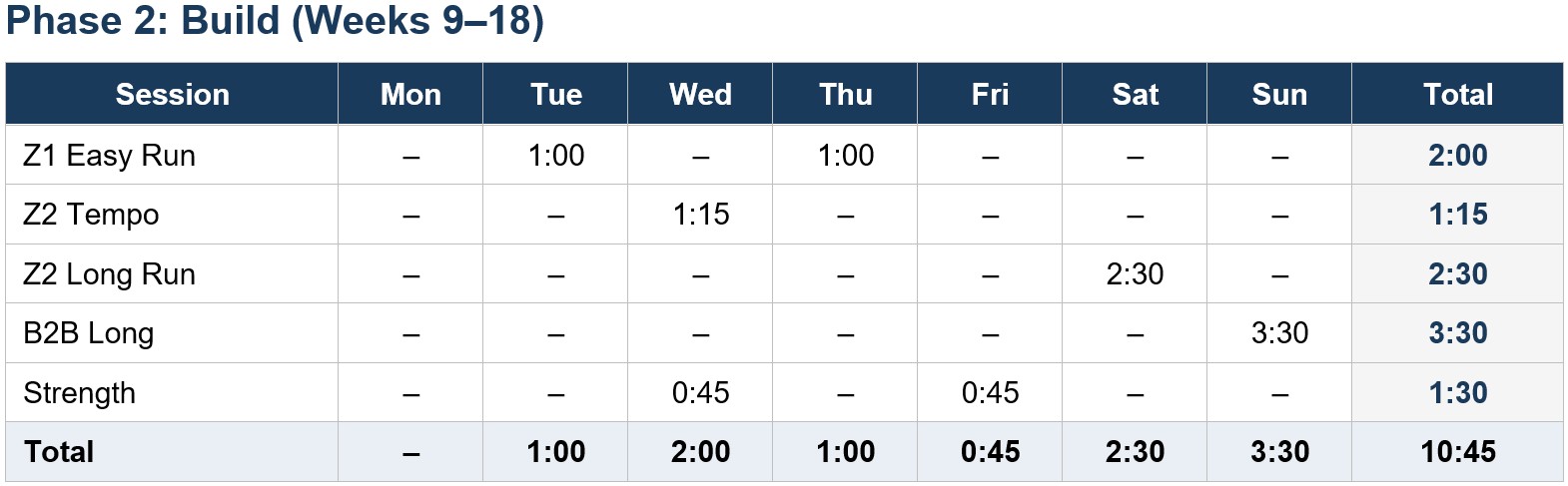
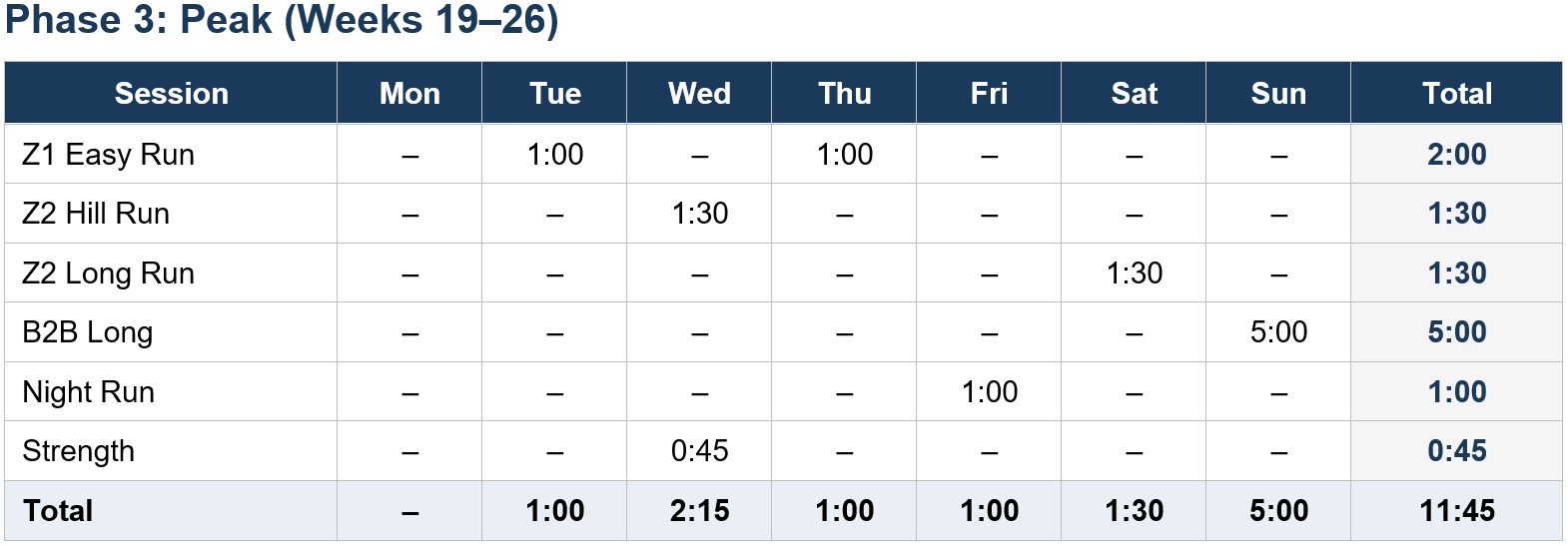
The heart of the training is the back-to-back long-run weekend: a long Z2 run on Saturday, followed by another long run on Sunday, on tired legs. These sessions simulate the cumulative fatigue of race day better than anything else. Every two to three weeks, a planned recovery week with reduced volume gives the body and the mind room to adapt.
Race-specific training matters. If your race involves a lot of climbing, you need to train climbing. Uphill runs, descents, trails, technical terrain — whatever waits for you on race day should already be familiar from training.
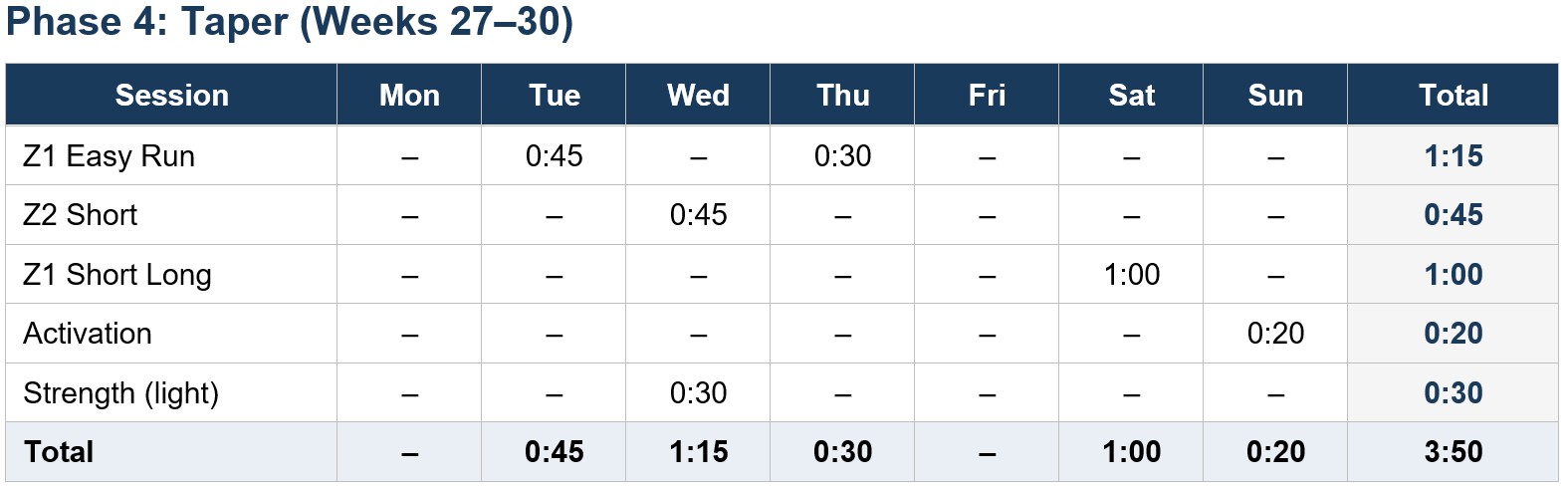
Example Training Structure (hours:minutes)
How the Body Adapts
Ultra training triggers profound physiological adaptations. The heart enlarges, the capillary network in the muscles becomes denser, and fat metabolism grows steadily more efficient — by running long and slow, you train your body to use fat as a primary fuel source, and your running economy improves along with it.
Tendons, ligaments, and cartilage take much longer to adapt than muscle does — often many months of progressive, systematic loading. And this is where the biggest injury risk lies: ramping up volume too fast, training too hard, recovering too little, or neglecting strength work can lead to all sorts of problems — shin splints, achilles tendonitis, plantar fasciitis, runner’s knee, stress fractures, etc. Nearly all of these come from overload, and nearly all of them are avoidable.
Learning to Deal With Fatigue
The mind wants to quit long before the body has reached its limit — sports science keeps confirming this. That’s why mental training is an integral part of ultra preparation. It’s about learning to tolerate discomfort and exhaustion, preparing yourself for the hard sections, and staying in the present moment instead of letting the kilometres still to come crush you.
Nothing great is easy.
Breaking the race into small segments (“just to the next aid station”), practicing positive self-talk, using back-to-back weekends consciously as mental training, and getting some night-time running into your build — all of these help.
Fuel for Long Efforts
During long training sessions and on race day, aim for 250–350 kcal per hour, drawing on a mix of carbohydrates (gels, bars, real food), electrolytes, caffeine, and fluids. If you don’t train your gut to handle this, you’ll pay for it on race day — gastrointestinal problems are the single most common reason for a DNF.
In day-to-day training, the priority is sufficient protein (2–2.2 g per kg of body weight) to support muscle repair and adaptation. Carbohydrates fuel your harder sessions, and quality fats support hormonal balance. Above all: eat enough. Ultra athletes have a tendency to under-fuel, with predictable consequences for recovery and injury risk. More on fueling for endurance events here and here. Here you can download sample weekly nutrition plan with suggestions for healthy eating, both for mixed diets and for vegetarians.
Strength Training as a Foundation
One to two strength sessions per week is essential. Focus on the muscle groups that matter most for running: glutes (for hip stability), quadriceps and hamstrings (for the climbs), calves (for shock absorption), plus core and shoulders for poling.
Single-leg exercises (Bulgarian split squats, step-ups, single-leg deadlifts) are particularly valuable, because they more closely match the actual running movement. Equally important is eccentric strength work for the quadriceps: running downhill, the muscles act as a brake — they have to produce force while lengthening and absorb the impact.
That’s why downhill running is genuinely hard, and it’s often what breaks ultra runners. Without specific preparation, the quads fatigue quickly. Eccentric training improves their capacity to handle that load, protects against injury, and helps you avoid “dead quads” in a race.
Strength training also lowers overall injury risk and improves running economy.
Recovery Is the Key
Training provides the stimulus but recovery is what makes the adaptation happen. Only with enough sleep can can the body actually convert training stress into improvement. Sleep is the single most important recovery tool — more important than massage, compression, cold plunges etc.
In demanding training blocks, schedule active recovery sessions: easy cycling, swimming, yoga, foam rolling, or sports massage. Combine that with enough sleep and, if it fits, a short power-nap during the day, and you’ve built the foundation for sustainable performance. Regular recovery weeks every two to three weeks are also non-negotiable for long-term progress.
In Closing
Ultra trail running isn’t for people without ambition — but it isn’t for superheroes either. It’s for those who are willing to commit to an adventure, to the process, to the doubts, to the moments when it gets hard.
What stays with you? The confidence that you can do more than you thought. The certainty that high standards and hard work pay off. The experience that you’re stronger than you believed — and a deep gratitude for being healthy and strong enough to take on a project like this.
Everything you need for a fulfilled life is on the other side of hard.