Fuelling for long-course triathlon
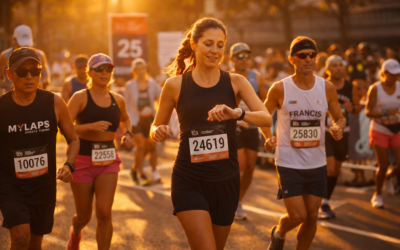
Imagine this: you’ve trained for months. Your swim, bike and run is on pace. Race day comes—and by K 25 of the marathon, you’re walking. Not because of fitness or pacing, but because you ran out of fuel or your stomach shut down.
This happens quite often in Ironman and 70.3 races. In most cases, the issue isn’t fitness—it’s nutrition. More specifically, failing to treat nutrition as a discipline that must be trained, not just planned.
Swim, bike, run—that’s the traditional model. But experienced athletes know there’s a fourth discipline: nutrition. It’s what determines whether your fitness actually shows up on race day. The athletes who get it right don’t improvise—they practise it the same way as their intervals and long rides.
Nutrition is trainable
Many athletes think race nutrition is just about hitting numbers—X grams of carbs per hour, Y litres of fluid but it’s not that simple.
Your gut is trainable. Its ability to absorb carbohydrates and tolerate intake under stress improves with practice. Research shows that athletes who consistently train with higher carbohydrate intake can absorb and use more during racing.
At race intensity, blood flow shifts away from digestion toward working muscles. Gastric emptying slows, and the gut becomes more sensitive. Any nutrition strategy that hasn’t been rehearsed under similar conditions is likely to fail.
This is why “gut training” matters.
The energy demands
A full Ironman can cost 8,000–12,000 kcal; a 70.3 about half that. The key point: at race intensity, carbohydrate is the primary fuel. Fat stores are abundant, but fat can’t be converted to energy fast enough to sustain race pace.
You will always need carbohydrates.
The bike leg is where your race is fuelled. The run simply exposes whether you got it right.
Why?
-
- It’s the longest portion of the race
- Gut tolerance is higher on the bike
- What you take in on the bike determines your run performance
Think of it this way: the bike is where you refuel; the run is where you spend it.
Carbohydrate targets
Old guidelines capped intake at ~60g/hour. Newer research shows that combining glucose (or maltodextrin) with fructose allows absorption of 90–120g/hour in trained athletes.
A practical framework:
-
- 60–75g/hour: entry level, building tolerance
- 75–90g/hour: achievable with structured training
- 90–120g/hour: advanced, requires a well-trained gut
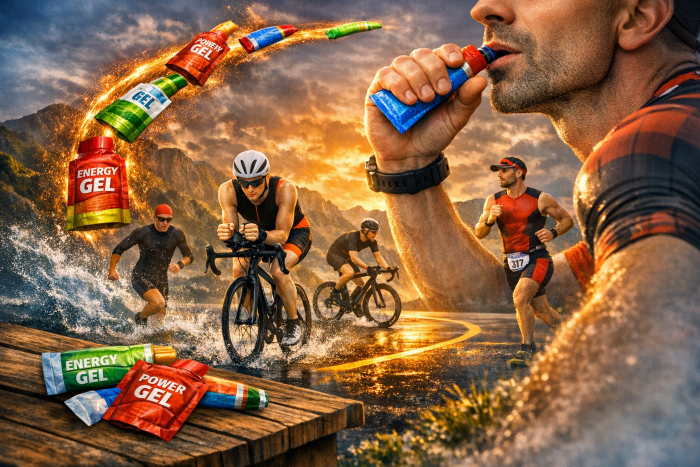
Form matters. Gels and liquids are easy to consume and absorb; solid foods provide variety but become harder to tolerate later. Most athletes do best with a mix—leaning toward liquids and gels as intensity rises.
One common mistake: delaying fuelling. Start within the first 20–30 minutes of the bike, when intensity is lower and absorption is easier.
How carbs support recovery
-
- They speed up glycogen replenishment, especially in the first hours after exercise
- They help reduce stress hormones such as cortisol
- They support the immune system, which is often weakened after long efforts
- When combined with protein, they promote muscle repair through an enhanced insulin response
- A simple rule applies: You don’t benefit from training that isn’t adequately fuelled and recovered from.
Especially in long-distance athletes with a high training frequency, insufficient nutrition after sessions is a common cause of stagnation, illness, or structural issues.
Recovery nutrition is not a luxury — it is a prerequisite for training to have an effect.
Run fuelling
Running changes everything. Impact, reduced blood flow to the gut, and accumulated fatigue make the gut more sensitive. Many athletes drop from 80g/hour on the bike to 30–50g/hour on the run.
But fuelling is still essential—especially in the second half.
Key points:
-
- Practise run fuelling separately
- Use more liquid sources (sports drink, maybe cola later on)
- Take in fuel early, not reactively
Don’t wait until you feel depleted. You will regret it.
Hydration and electrolytes
Hydration and fuelling are related but separate. Trying to meet both needs with one drink often leads to problems—either under-hydration or gut overload.
A better approach:
-
- Use water with electrolytes or a lower-carb or diluted drink for hydration
- Use gels/chews or a separate source for carbs
- Add additional electrolytes independently if needed
Sodium matters. Sweat sodium levels vary a lot between individuals. If you’re a “salty sweater,” you’ll need more. Failing to replace sodium increases the risk of hyponatraemia, cramps and nausea.
On race day:
-
- Drink to thirst
- Take in sodium consistently (practice during training)
- Adjust electrolytes for heat, not just fluid
Pre-race nutrition
The 24–48 hours before the race matter.
-
- Increase carbohydrate intake (8–10g/kg bodyweight)
- Reduce fat and fibre
- Avoid unfamiliar foods
Race morning:
-
- Eat 3 hours before start
- Choose simple, tested foods (e.g. white bread with honey, rice)
- Aim for about 500 – 600 calories for breakfast and take a caffeine gel 20 minutes before the start.
- Hydration: Take 500 ml of zero carb electrolyte drink with breakfast. Sip an additional 2 dl until 1 hour before the start.
Caffeine is a great booster. It peaks ~45–60 minutes after intake and can improve alertness and perceived effort. A gel with 100 mg 20 min. before the start is a good choice. Take additional caffeine gels every 3 hours. Test your tolerance for caffeine in training!
Six common mistakes
Starting too late on the bike
→ Begin fuelling within 20–30 minutes
Using untested race nutrition
→ Practise everything in training
Eating solids too late
→ Transition to gels/liquids in the second half
Drinking on a rigid schedule
→ Adjust based on thirst and conditions
Ignoring run gut sensitivity
→ Practise run-specific nutrition
Under-fuelling training
→ Fuel properly also during training to support adaptation and performance
Conclusion
Nutrition isn’t something you figure out the week before your race. It requires the same deliberate, structured approach as your training.
The good news: the gut adapts. If you build it progressively, practise in realistic conditions, and refine your strategy, your nutrition will become automatic.
Nutrition and fuelling is often what separates athletes who run well off the bike from those who don’t.
Click here for step by step guidance to fueling an Ironman. Here you can download a sample weekly nutrition plan with suggestions for healthy eating, both for mixed diets and for vegetarians.
References (selected)
-
- Jeukendrup AE. Training the gut for athletes. Sports Medicine.
- Jeukendrup AE, Jentjens RLPG. Carbohydrate intake during exercise and performance nutrition.
- Martinez IG et al. The effect of gut‑training on gastrointestinal function and endurance performance. Sports Medicine.
- Burke LM et al. Carbohydrates for training and competition. Journal of Sports Sciences.