The Day After
Sleep, nutrition and regeneration determine your performance
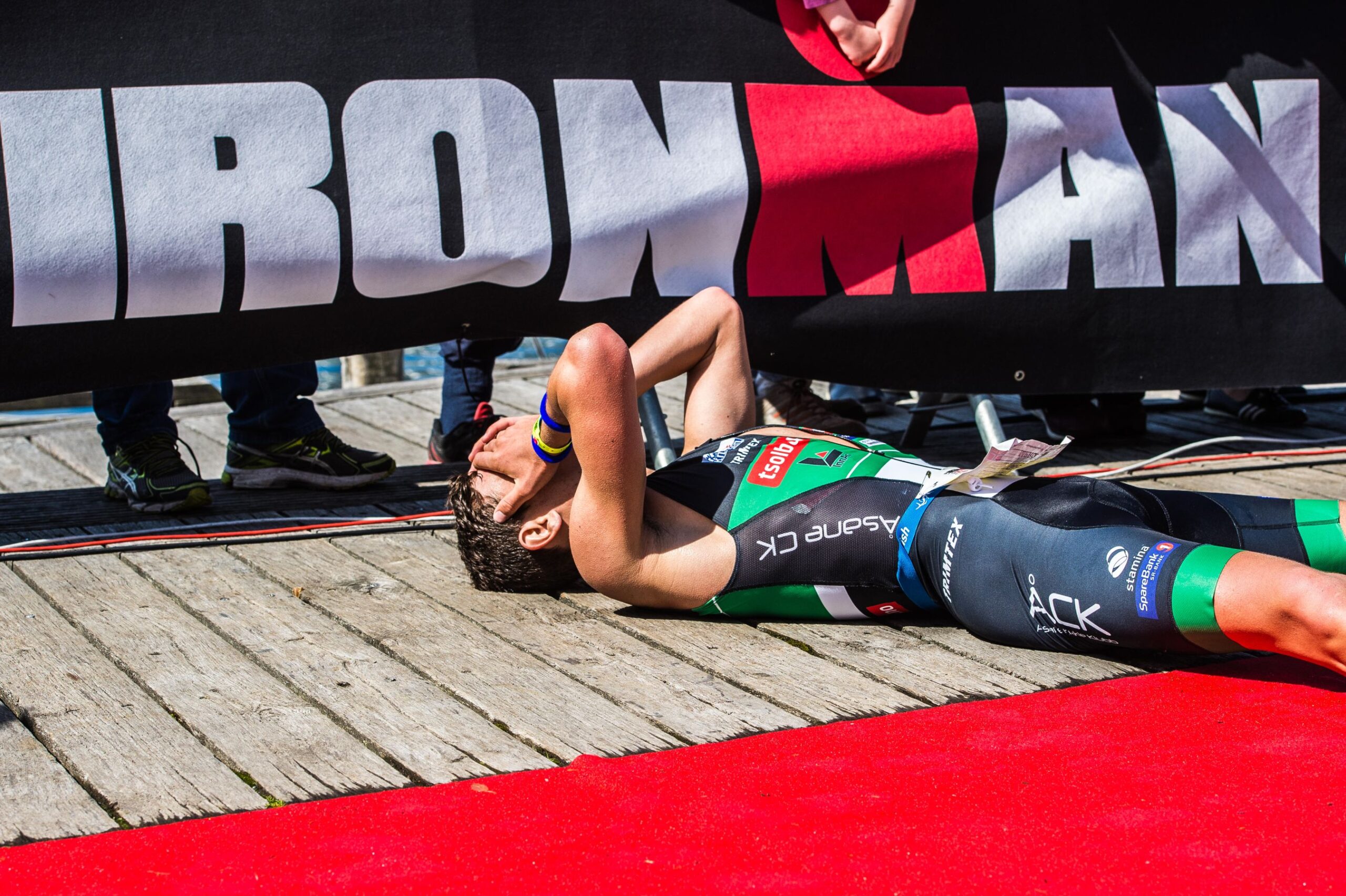
You know the feeling: yesterday you crossed the finish line of an Ironman, completely exhausted. Today, even walking hurts, and you’re wondering what you need to do to feel normal again—or when and how you can return to training.
Or maybe it’s this: the last few weeks of training have been relentless. Your legs feel heavy, your motivation has disappeared somewhere along the way, and even your morning coffee has lost its kick.
Moments like these reveal an important truth: recovery is not a luxury. It is a fundamental part of training — the phase in which your body actually becomes stronger. In order to use recovery effectively, it helps to understand what is happening inside your body during both training and rest.
What Endurance Training Does to Your Body
Every hard session leaves its mark.
The most obvious effects are in your muscles. Intense efforts—especially downhill running or explosive work on the bike—create microscopic tears in muscle fibers. This triggers an inflammatory response: immune cells move in, clear damaged tissue, and the body rebuilds those structures stronger than before. That process is adaptation, but it requires both time and resources.
At the same time, long or intense sessions drain your glycogen stores. Glycogen is the body’s stored form of carbohydrates, found mainly in the muscles and liver, and it serves as the primary fuel source for moderate- to high-intensity exercise. Even with optimal nutrition, fully replenishing these stores can take 24–48 hours.
What many endurance athletes underestimate is the fatigue placed on the nervous system. The central nervous system (CNS) coordinates every movement — every stride, pedal rotation, and swim stroke. Prolonged exertion reduces neurotransmitters such as serotonin and dopamine, leading to poorer concentration, less precise movement, and declining motivation for the next session. This is not a mindset issue; it is physiology.
Training also affects your hormonal balance. Cortisol rises during intense exercise, which is both normal and necessary to mobilize energy. Problems arise only when cortisol remains chronically elevated. Over time, the testosterone-to-cortisol ratio declines, and with it your ability to recover effectively.
During a Hard Training Block: Recover While You Build
A three- to four-week training block only leads to progress if recovery is treated with the same seriousness as the workload itself. Recovery does not simply mean “training less.” It means making targeted adjustments.
In a recovery week, training volume is typically reduced by 40–50% compared to the build phase. However, some intensity remains. Short tempo efforts or controlled intervals keep the neuromuscular system engaged and preserve the training stimulus.
What disappears are the long, draining sessions: no three-hour runs, no epic bike rides. Instead, training becomes shorter, sharper, and more focused. Quality replaces quantity, supported by deliberate rest days. If a recovery week feels “too easy,” that usually means you are doing it correctly.
Sleep is your most powerful recovery tool. During deep sleep, the body releases growth hormone, which is critical for repair and adaptation. Losing an hour of sleep often has a greater impact than skipping any recovery intervention. During demanding training phases, 8–9 hours of sleep are not a luxury—they are a requirement.
Nutrition matters just as much. After intense sessions, your body needs carbohydrates quickly—around 1–1.2 g per kilogram of body weight within the first hour—along with 25–30 g of protein to begin the recovery process. Across the day, total protein intake should reach roughly 1.6–2.2 g per kilogram, ideally spread into servings of about 25 g each. Under-fueling during a build phase undermines one of the most important foundations of adaptation.
Heart rate variability (HRV) can also serve as an early warning system. Measured first thing in the morning, before getting out of bed, HRV reflects how recovered your autonomic nervous system is. If values remain below your personal baseline for several consecutive days, it is not a sign of weakness—it is a clear signal to reduce training load.
And finally, there is active recovery. Easy movement in Zone 1—such as walking or relaxed swimming—promotes circulation, improves nutrient delivery to tissues, and supports the removal of metabolic byproducts. In many cases, it is more beneficial than remaining completely inactive.
After the Ironman: Structuring the Weeks That Follow
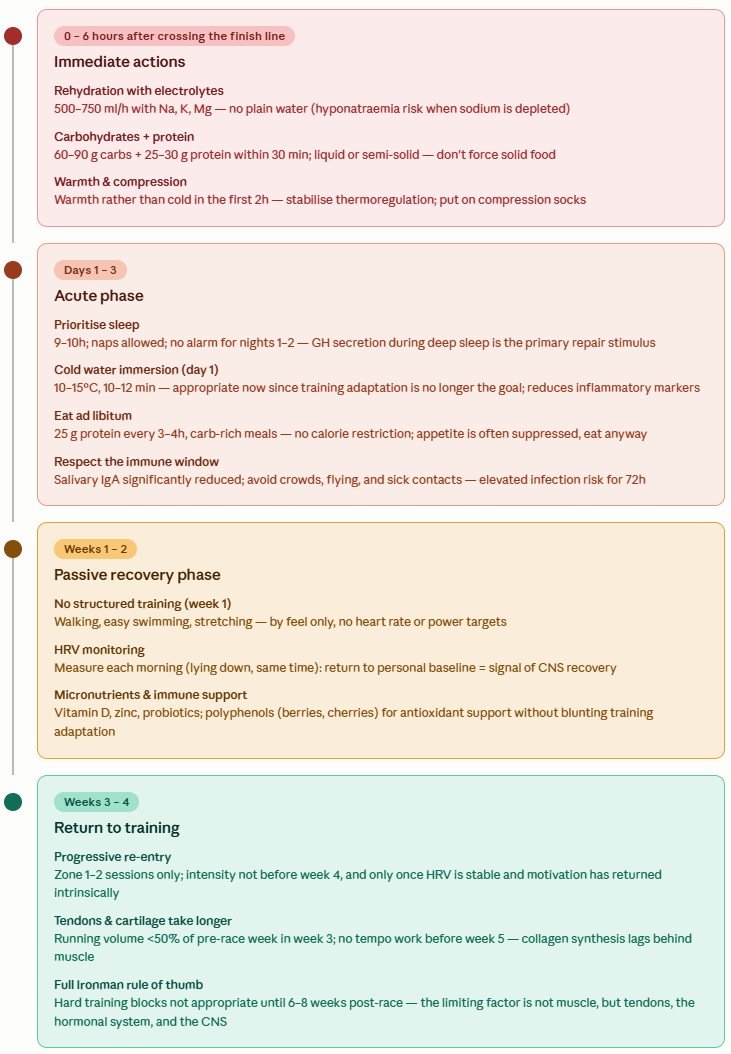
An Ironman is not a normal training stress. Ten or more hours of continuous effort place enormous strain on the muscles, immune system, hormonal system, tendons, and nervous system alike.
That is why post-Ironman recovery needs structure.
The Key Takeaway
Training itself does not make you faster—recovery does. Athletes who understand this and give recovery the same importance as their hardest sessions are the ones who become stronger over the long run.
Main Sources (Selection)
- Anderson, Lane & Hackney (2016): Cortisol and testosterone dynamics following exhaustive endurance exercise. European Journal of Applied Physiology, 116(8), 1503–1509 — Cortisol/testosterone dynamics after intense endurance exercise; recovery period 48–72 hours
- Burke, van Loon & Hawley (2017): Postexercise muscle glycogen resynthesis in humans. Journal of Applied Physiology, 122(5), 1055–1067 — Glycogen resynthesis, optimal carbohydrate dosing, and 24–48-hour replenishment time
- Van Cauter & Plat (1996): Physiology of growth hormone secretion during sleep. Journal of Pediatrics, 128(5), S32–37 — Growth hormone release during deep sleep as a primary anabolic repair stimulus
- Meeusen et al. (2006): Central Fatigue—The Serotonin Hypothesis and Beyond. Sports Medicine, 36(10), 881–909 — CNS fatigue, serotonin/dopamine imbalance, and loss of motivation during endurance exercise
- Neubauer et al. (2008): Recovery after an Ironman triathlon: sustained inflammatory responses and muscular stress. European Journal of Applied Physiology, 104(3), 417–426 — Inflammatory markers and immune response for several days after an Ironman
- Buchheit (2014): Monitoring training status with HR measures: do all roads lead to Rome? Frontiers in Physiology, 5:73 — HRV as a sensitive marker for autonomic CNS recovery in endurance athletes
- Morton et al. (2018): A systematic review, meta-analysis and meta-regression of the effect of protein supplementation on resistance training-induced gains. British Journal of Sports Medicine, 52(6), 376–384 — Evidence base for the protein recommendation of 1.6–2.2 g/kg body weight