
Is Good Pacing an Art or a Science?
Few things decide a race as much as the pace you choose. Months of training, solid nutrition, and motivation can all be undone by the wrong tempo in the first few kilometers. Pacing is therefore one of the core skills in endurance sport: the art of finding your limit and distributing your available energy across the distance so that you cross the finish line “completely spent” – without blowing up beforehand. Is that a learnable craft, grounded in physiology and numbers, or does it remain a matter of feel, an art? As so often, the answer lies somewhere in between.
A Budget That Can Do More Than Just Shrink
The simplest analogy for pacing comes from the world of personal finance: you have a limited budget for the distance, and you can’t spend it all before the next “paycheck” arrives. Spend too much in the first half of the race and you’ll run out of money to cover the rest of the bill. But there’s one crucial difference from a financial budget: in sport, you don’t just drain your account – you simultaneously generate unwanted “overhead costs” in the form of metabolic byproducts that accumulate in your muscles.
Poor Pacing Triggers a Domino Effect
Runners who go out too fast create a high metabolic load early on, triggering a chain reaction. Hydrogen ions and inorganic phosphate, produced by intense metabolism and the breakdown of creatine phosphate, directly impair force production in the muscle fiber. At the same time, glycogen stores empty faster, heart rate drifts upward at the same output, and core body temperature rises more quickly.
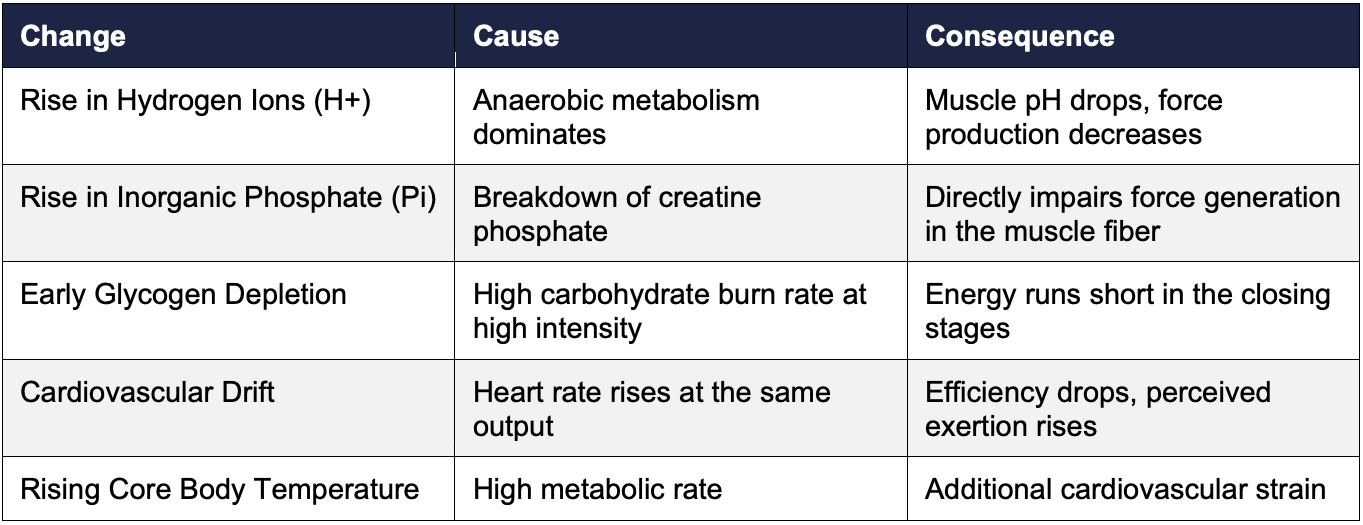
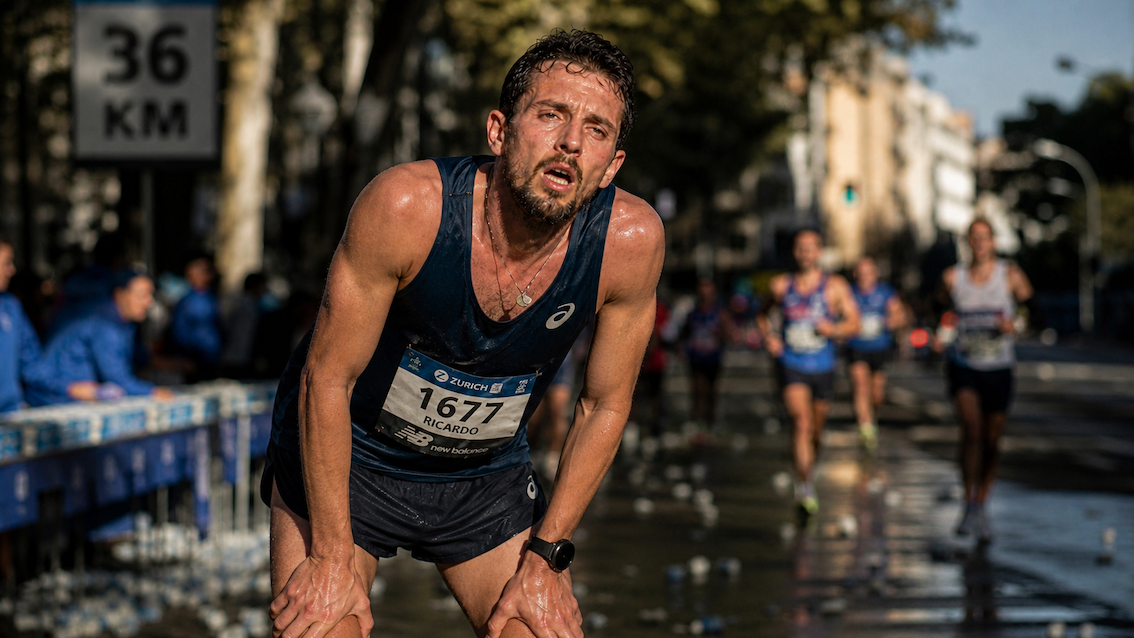
The result is the classic late-race collapse: pace often drops by 20 to 40 seconds per kilometer, sometimes more. That’s not just unpleasant – it costs serious time.
Why Even Pacing Wins
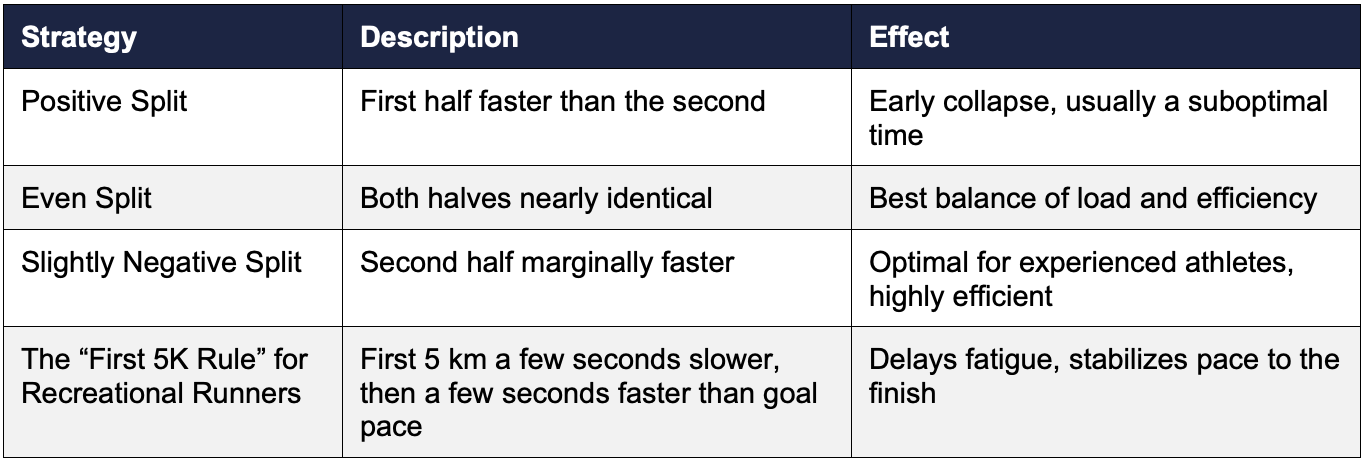
On flat courses, the fastest marathon times in history have been run almost exclusively with even or slightly negative splits – the second half run at the same pace or marginally faster than the first. For recreational runners on flat courses, it’s even worth running the first five kilometers a few seconds slower than goal pace, then a few seconds faster afterward. This delays glycogen depletion, the rise in body temperature, and metabolic load, preserving reserves for the closing stages.
Effort, Not Pace
Good pacing means, above all, an even effort – not necessarily an even pace. Course profile, weather, and mounting fatigue constantly change how “expensive” a given pace is for your body. Many runners struggle with pacing because they rely too heavily on their watch and too little on their internal sense of effort. The number on the display stays fixed, while the real strain behind it keeps changing. Runners who watch only their pace often notice the warning signs too late.
Signals Worth Paying Attention To
Heart rate, breathing rhythm, how your leg muscles feel, perceived exertion (RPE, Rate of Perceived Exertion), and current pace together form the full picture. None of these signals alone is reliable enough – only the combination lets you judge whether you can sustain the current pace all the way to the finish.
Pacing Is Learned in Training
Interval sessions are an excellent way to practice pacing, because they force you to consciously control the intensity of every rep. Runners who go out too hard on the first intervals blow up later. Running them evenly trains exactly the skill that matters on race day.
But beyond interval training, every ordinary run is also an opportunity to train your pacing sense. During a run, regularly try to estimate your current pace before checking your watch, then compare your guess with the actual number. Over time, you’ll build a better feel for different tempos and learn to control your pace more and more precisely by feel alone.
The Brain as Central Regulator
The brain is your most important pacing partner. It constantly monitors signals from your muscles, heart, temperature receptors, and metabolism, trying to predict whether the current effort can be sustained long-term. If the forecast looks bad, it intervenes – often unconsciously – and dials back intensity. It’s a highly complex regulator that governs both consciously, through perceived exertion (RPE), and unconsciously, through protective mechanisms.
How Do You Find a Realistic Goal Pace?
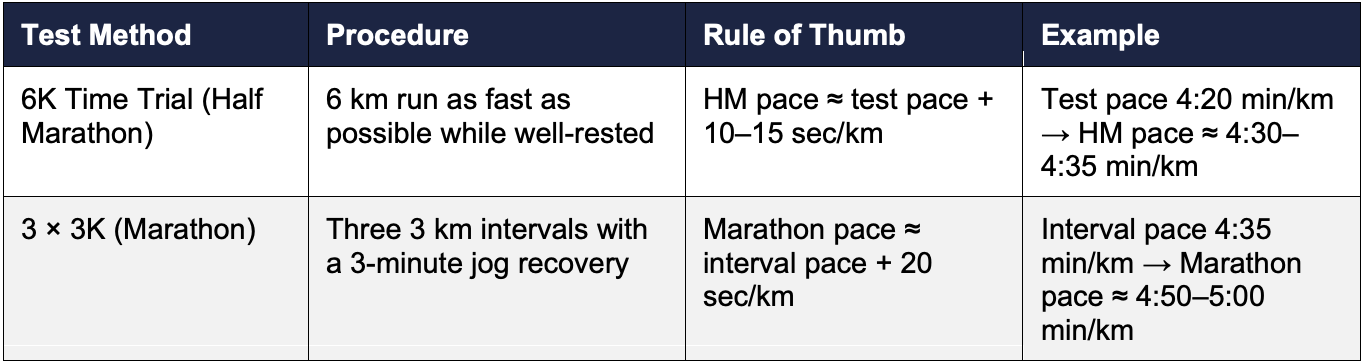
Runners without a prior race time to work from need an objective test. The following two methods provide a solid benchmark: a 6-kilometer time trial for half marathon pace, and three times three kilometers for marathon pace:
So pacing is neither pure art nor pure science. It’s the intersection of physiological understanding and practical experience. Runners who understand how energy production, metabolite accumulation, and glucose management interact can steer their pace to get the absolute most out of their body. A well-paced half marathon or marathon feels hard – but controlled and efficient. A poorly paced race, by contrast, is a fight against your own body.
Pacing is the tool that decides whether you fulfill your potential or give it away. Master it, and you don’t just run faster – you run smarter.

Key Sources (Selection)
- Allen, Lamb & Westerblad (2008) – H⁺/Pi as fatigue mechanisms rather than lactate
- Díaz, Fernández-Ozcorta & Santos-Concejero (2018) – even/negative pacing in marathon world records
- Borg (1982) – foundational work on the RPE concept