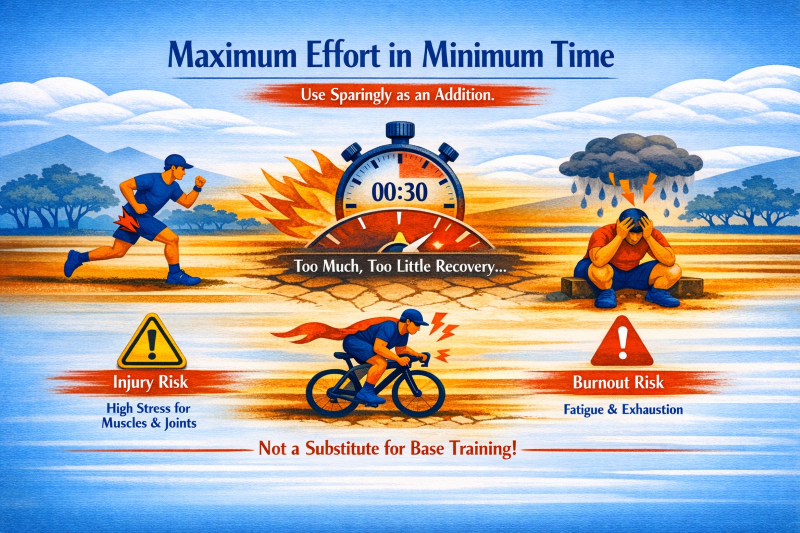
HIIT: Maximum Stimulus in Minimum Time – But With Clear Limits
More articles in this series: Overview of the Most Popular Training Methods | Part 1: Pyramidal Method | Part 2: Threshold and Sweet Spot Method | Part 3: HIIT Method | Part 4: Polarised Training Method | Part 5: The Norwegian Method
Short, sharp, effective – HIIT has a reputation as the universal solution in the fitness world. Train high-intensity when time is short, and you’ll get fast. This logic sounds compelling. It’s even partly true – but only under specific conditions, in the right phase, and at the right dose. For endurance athletes in running, cycling, swimming or triathlon, HIIT is a powerful tool that does more harm than good when misapplied.
HIIT is the spice, not the main ingredient. Athletes who build their training plan primarily around intervals have misread the recipe.
What HIIT Is – and What It Isn’t
HIIT means High Intensity Interval Training: short to medium efforts at very high intensity – typically 85–100% of maximum heart rate or above – broken up by active recovery periods. The critical distinction: HIIT works clearly above the lactate threshold, in the anaerobic zone. Tempo runs at marathon pace, fartlek, or threshold intervals are separate methods with a different stimulus profile.
The most relevant protocols differ in effort duration, recovery design, and intensity target:
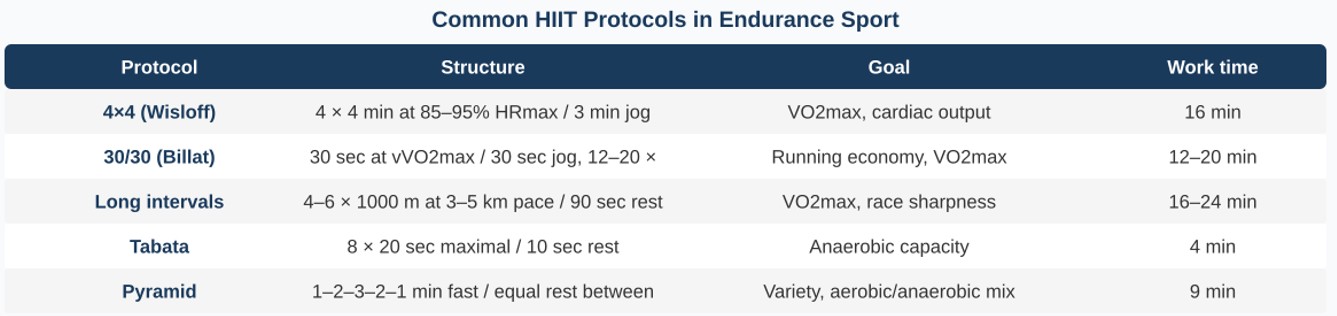
For endurance athletes, the 4×4 protocol (Wisloff) and the 30/30 method (Véronique Billat) are the most relevant: both target the VO2max zone precisely without driving the body into full acidosis, and both integrate well into a periodised running plan.
What HIIT Does to the Body
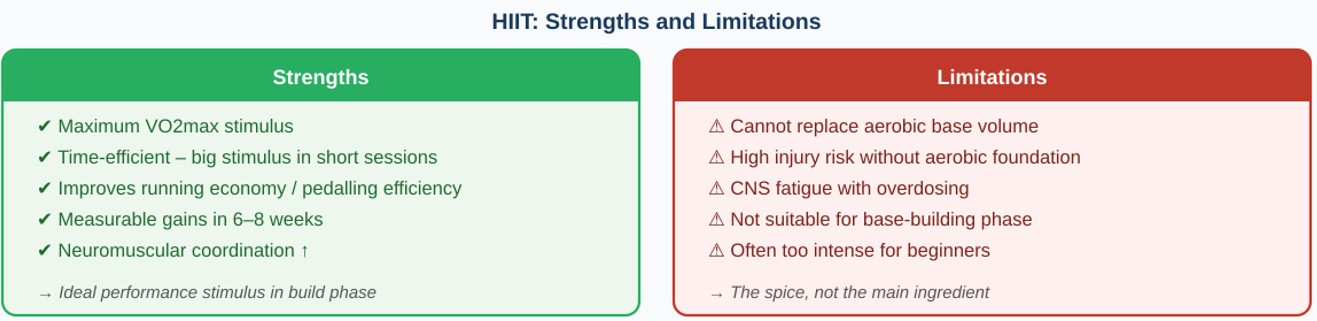
The key stimulus: HIIT challenges the cardiovascular system at an intensity that easy aerobic training never reaches. Stroke volume, cardiac output and VO2max improve measurably after six to eight weeks of consistent training. Added to this is improved lactate buffering capacity – the body learns to tolerate higher lactate concentrations – and direct neuromuscular adaptation that improves running economy and cadence.
The downside: recovery demand after a genuine HIIT session is significant. The central nervous system is taxed harder than with threshold or base training. Stack two to three HIIT sessions per week without enough easy work between them, and you’ll accumulate nervous fatigue that shows up as falling performance, disturbed sleep and increased susceptibility to illness.
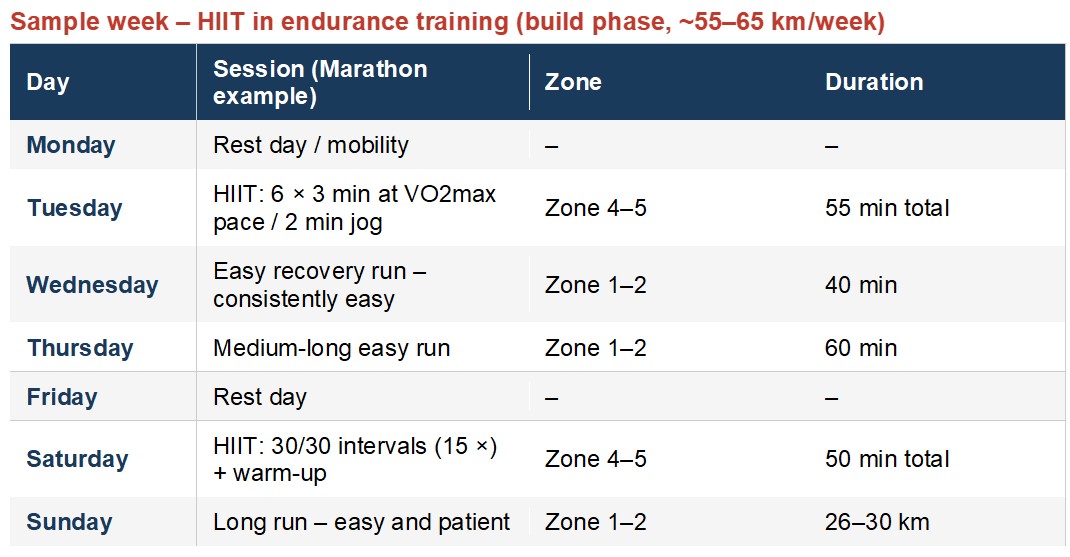
Weekly Structure in Practice
Maximum two HIIT sessions per week – embedded in a predominantly aerobic training framework. The long Sunday run stays untouched: it’s not a victim of time efficiency, it’s an indispensable aerobic anchor. For triathletes: HIIT stimuli are concentrated in one or two disciplines, never all three simultaneously.
Common Mistakes
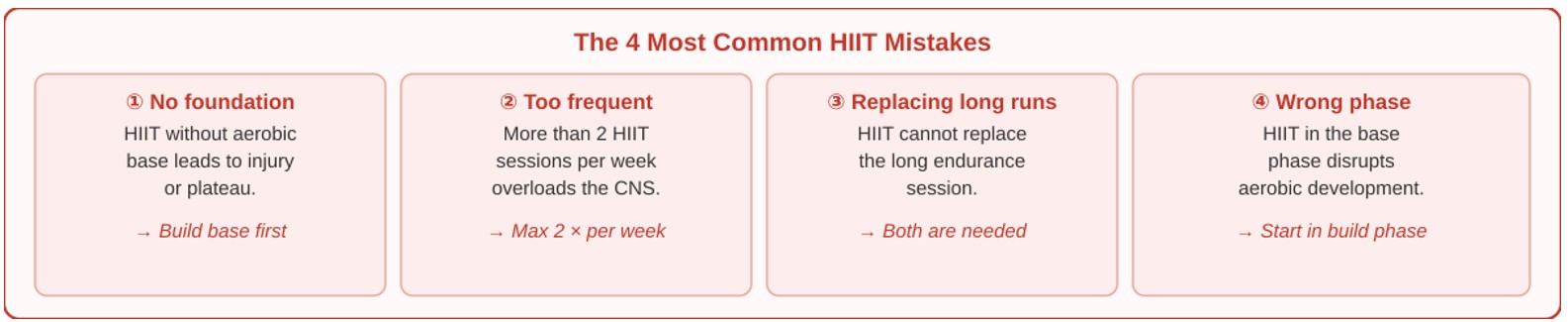
The most common mistake: HIIT without an aerobic foundation. Tendons, ligaments and bones adapt far more slowly than the cardiovascular system – starting high-intensity intervals without a base frequently ends in stress reactions, shin splints or Achilles problems. The second most common mistake is wrong timing: HIIT during the base-building phase disrupts aerobic development because the body doesn’t yet have the recovery capacity.
When HIIT Makes Sense – and When It Doesn’t
Appropriate: In the build and peak preparation phase, when the aerobic base is already solid. As a targeted VO2max stimulus once or twice per week. For experienced athletes looking to raise a specific performance ceiling. Applies across all endurance disciplines: track intervals for runners, VO2max blocks on the ergometer, sprint sets in the pool – the stimulus character is the same.
Not appropriate: As the dominant method for time-pressed athletes trying to replace long aerobic sessions. During the first 12–16 weeks of a race cycle’s base phase. For beginners without a running base. Immediately after intensive race blocks or injury comebacks.
Six to eight weeks of HIIT can raise your VO2max ceiling. But the ceiling sits on top of a pot – and that pot is built with aerobic kilometres.
Conclusion
HIIT earns its place in endurance training – but a precisely defined one. As a VO2max stimulus in the right phase, dosed at one or two sessions per week, on a solid aerobic foundation: then HIIT is a genuine performance lever. As a replacement for volume, or as a universal fix for lack of time, it misses the mark.
In the next part of this series we look at polarized training.
Main Sources (Selected)
- Jan Helgerud et al. (2007) – Circulation – Original study on the 4×4 protocol; demonstrated superior cardiovascular adaptations from aerobic interval training compared with moderate continuous training
- Jan Helgerud et al. (2007) – Medicine & Science in Sports & Exercise – Showed that high-intensity intervals improve VO2max more effectively than moderate training
- Véronique Billat – Research on the 30/30 method at the University of Lille; foundational work on vVO2max as a training parameter, published among others in the European Journal of Applied Physiology
- Polarized training / 80/20 principle (Stephen Seiler) – Framework for distributing high-intensity versus easy training sessions
- Training recommendations from the IRONMAN coaching environment for cross-disciplinary HIIT dosing