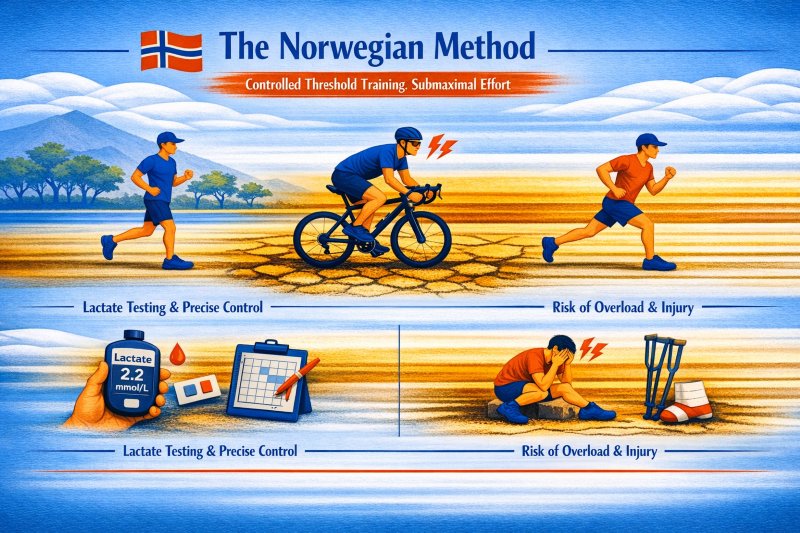
The Norwegian Method: Double Threshold, Half the Intensity – and Still Faster
How the Norwegians redefined threshold training – and what recreational athletes can learn from it.
More articles in this series: Overview of the Most Popular Training Methods | Part 1: Pyramidal Method | Part 2: Threshold and Sweet Spot Method | Part 3: HIIT Method | Part 4: Polarised Training Method
Train twice a day – but not with sprints or hard intervals. Instead, controlled threshold runs at a surprisingly moderate intensity. The Norwegian Method sounds counterintuitive. And yet it produced Jakob Ingebrigtsen as Olympic champion and world record holder over 1500 m and 5000 m. What lies behind it – and what does it mean for athletes who aren’t full-time professionals?
The Norwegians train slower than expected – and still get faster than everyone else. The secret is frequency, not intensity.
What the Norwegian Method Means
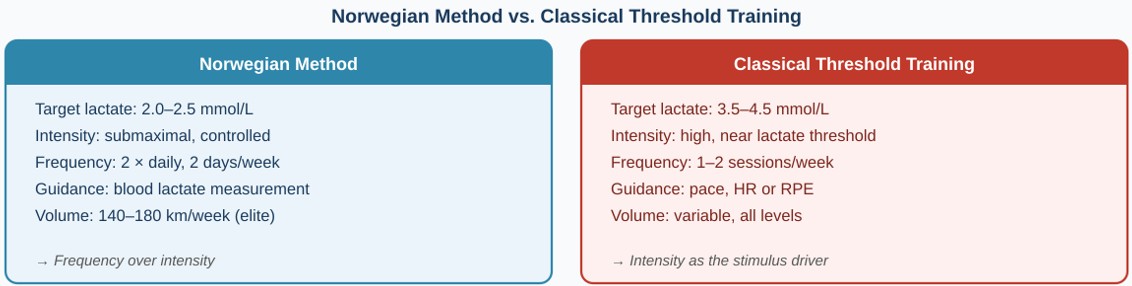
Developed by coach Marius Bakken, the method rests on one central idea: threshold work can be dosed more frequently if the intensity stays low enough. Instead of hitting the classical 4 mmol/L lactate threshold once a week, athletes train twice daily – on two days per week – at 2.0 to 2.5 mmol/L. Submaximal, controlled, and crucially: repeatable.
Intensity is not managed through pace or heart rate, but through blood lactate measurements taken directly on the track. A finger-prick after each interval set shows whether the effort is within target range. This sounds demanding – and it is. For elite athletes with a support team, it’s standard practice; for age-groupers, heart rate or RPE is the pragmatic substitute.
Why Submaximal Still Works
The logic is elegant: at 2.0–2.5 mmol/L lactate, the body is still clearly in the aerobic zone – the effort is sustainable, recovery between double sessions is possible. What the method achieves is to massively increase the cumulative threshold work across the week, without overloading the central nervous system. A classically trained runner might accumulate 20–30 minutes of threshold work per week. An elite athlete using the Norwegian method accumulates a multiple of that – at lower individual intensity, but far higher frequency.
There’s a further key advantage: because intensity stays low enough, running mechanics remain stable. Exhausted athletes run poorly. Controlled threshold runs at 2.5 mmol/L allow clean technique throughout the session – and therefore better running economy over the long term.
Weekly Structure: Adapted for Age-Groupers
In its original form, the Norwegian method is not applicable for hobby athletes: training twice daily requires recovery capacity reserved for full-time professionals with optimised sleep, nutrition, and lifestyle. What can be adapted is the core philosophy – submaximal, frequent, precise.
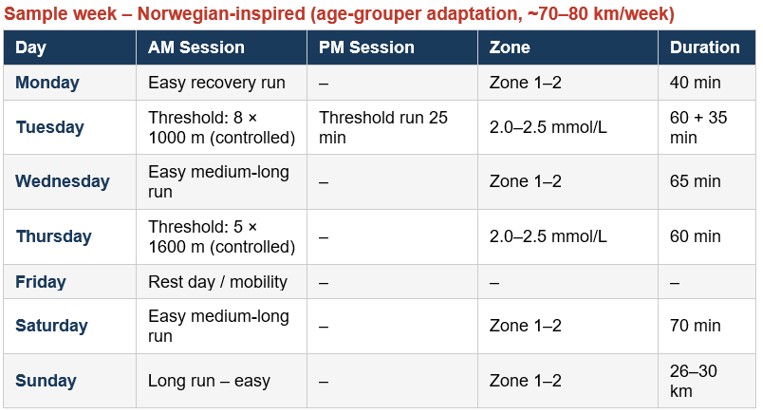
Tuesday includes the double session – morning intervals, evening threshold run. Thursday uses one controlled session. Everything else stays firmly in Zone 1–2. For triathletes, the double session can cross disciplines – morning bike intervals, evening swim threshold work.
What Age-Groupers Can Take Away

The most important lesson from the Norwegian method is not the double session – it’s intensity discipline. Most amateur athletes run their threshold sessions too hard: they target 4 mmol/L or above because it feels like ‘real work’. The result is one exhausting session instead of several controllable stimuli. Running fewer efforts at lower lactate – and recovering properly between them – is a principle that translates directly into any training framework.
Common Mistakes
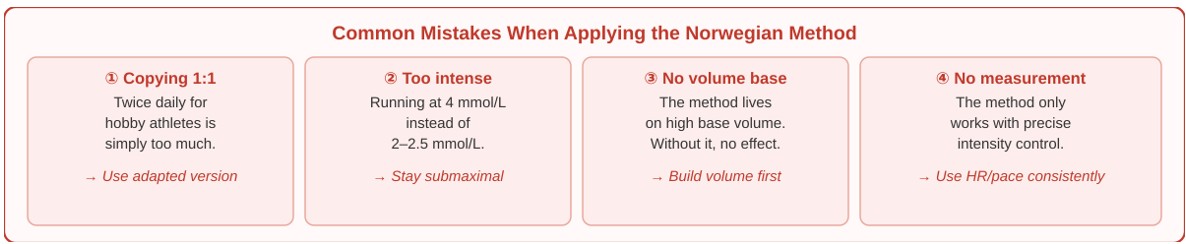
The most common mistake is the direct copy attempt: twice daily without the matching volume, recovery infrastructure and lactate testing quickly overwhelms any working athlete. The second most common mistake is the opposite intensity error – those who try to adopt Norwegian submaximality end up simply running ‘kind of easy’ without the necessary structure and control. The method demands precision, not vagueness.
The Norwegian method works not because you train twice a day. It works because you train twice a day precisely.
Conclusion
The Norwegian method is not a training plan for age-groupers – it’s a philosophy from which concrete principles can be drawn: set threshold work lower, repeat it more often, execute it more precisely. Those who integrate this into their polarized or pyramidal framework are training with the spirit of the method – without a lactate meter or double sessions.
Main Sources (Selection)
- Casado, A., Foster, C., Bakken, M. & Tjelta, L.I. (2023) – “Does Lactate-Guided Threshold Interval Training within a High-Volume Low-Intensity Approach Represent the ‘Next Step’ in the Evolution of Distance Running Training?” – International Journal of Environmental Research and Public Health, 20(5), 3782. DOI: 10.3390/ijerph20053782 → The central primary scientific source on the LGTIT method, co-authored by Marius Bakken himself.
- Marius Bakken – Former Norwegian world-class runner (5000 m PB: 13:06) and physician; developer of the lactate-guided double-threshold method in the 1990s and key inspiration for the Ingebrigtsen family.
- Jakob Ingebrigtsen – Used as the central case study: Olympic champion and world record holder over 1500 m and 5000 m, the method’s most prominent practitioner.
- Tjelta, L.I. (2013) – “A Longitudinal Case Study of the Training of the 2012 European 1500 m Track Champion” – frequently cited background source on the Norwegian training model.
- General sport physiology (implicit) – Concepts such as lactate threshold (2.0–4.0 mmol/L), cumulative training load, and running economy; no single specific source, but consistent with standard references in endurance training science.