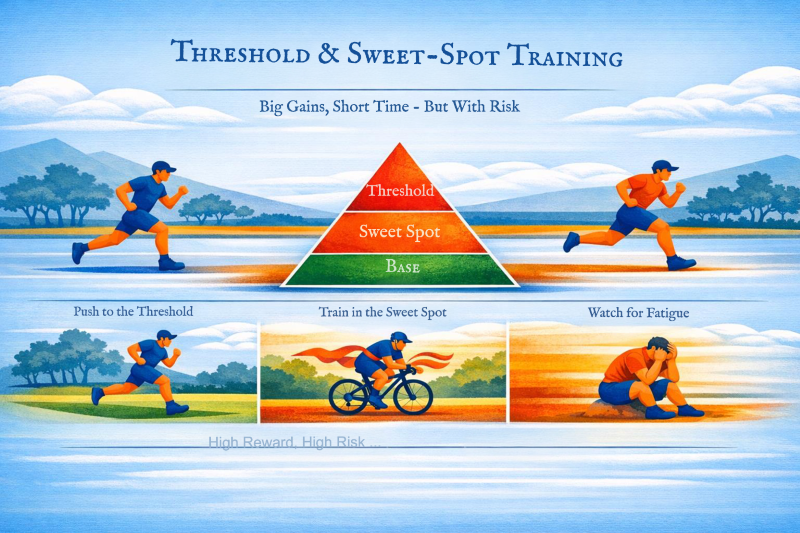
Threshold & Sweet-Spot Training: Big Stimulus, Less Time – But With Risk
More articles in this series: Overview of the Most Popular Training Methods | Part 1: Pyramidal Method | Part 3: HIIT Method | Part 4: Polarised Training Method | Part 5: The Norwegian Method
If you’re short on time, train harder. This logic is widespread – and not entirely wrong. Threshold and sweet-spot training deliver strong training stimuli in relatively short sessions, making them particularly popular with athletes working within a limited training budget. Whether you’re a marathon runner, cyclist or triathlete: the method promises noticeable progress within weeks. What it doesn’t promise – and can’t deliver – is sustainability without careful dosing and a solid aerobic foundation.
Threshold training is not a shortcut. It’s a tool – and like any tool, it can be used wrong.
What Threshold and Sweet-Spot Training Mean
The lactate threshold marks the intensity point where lactate production exceeds lactate clearance – the body can no longer compensate aerobically. Threshold training targets exactly this zone: intense enough for a strong adaptive stimulus, just controlled enough for longer blocks.
Sweet spot refers to the intensity just below the classical lactate threshold – Zone 3 to lower Zone 4. In cycling, this corresponds to roughly 88–93% of FTP. In running, it roughly equates to half-marathon to marathon pace for well-trained athletes.

Both variants – threshold and sweet spot – operate in the zone that polarized training deliberately avoids: the grey zone. This is not a contradiction; it’s a question of periodisation. Threshold work has its place – but a precisely defined one.
Why It Works – and Where the Limits Are
Regular threshold training shifts the lactate threshold upward: the body learns to work aerobically at higher intensities. This is directly relevant for race performance – marathon, Ironman bike leg, open water swimming – because race pace often falls exactly in this zone. Additional benefits include improved cardiac output, running economy, and lactate buffering capacity.
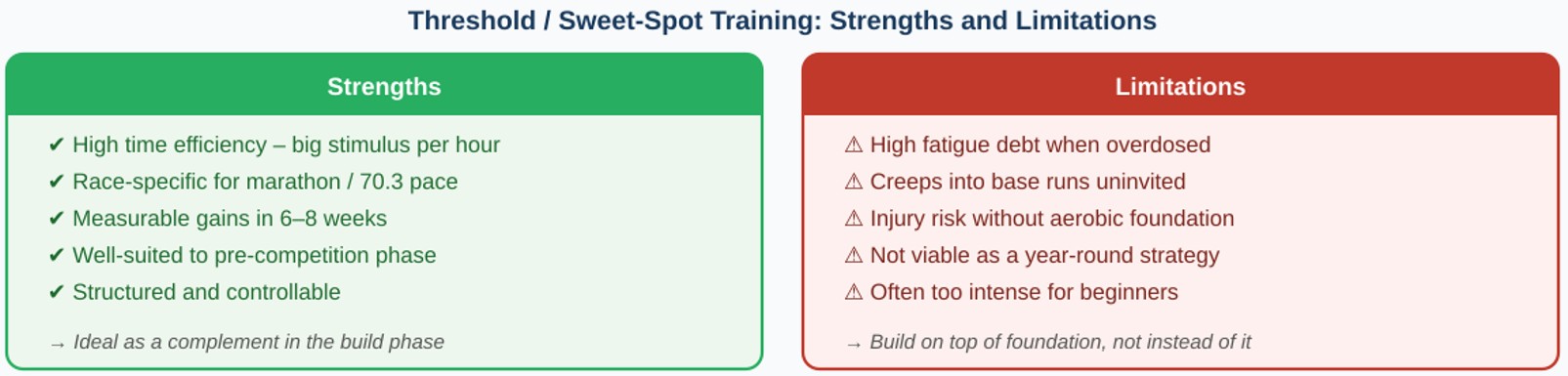
The problem: recovery demand after threshold sessions is high. Stack two or three per week without sufficient easy recovery work, and fatigue accumulates faster than it clears. The result is a gradual performance decline that typically only becomes apparent after four to six weeks – too late to trace back to the cause clearly.
Weekly Structure in Practice
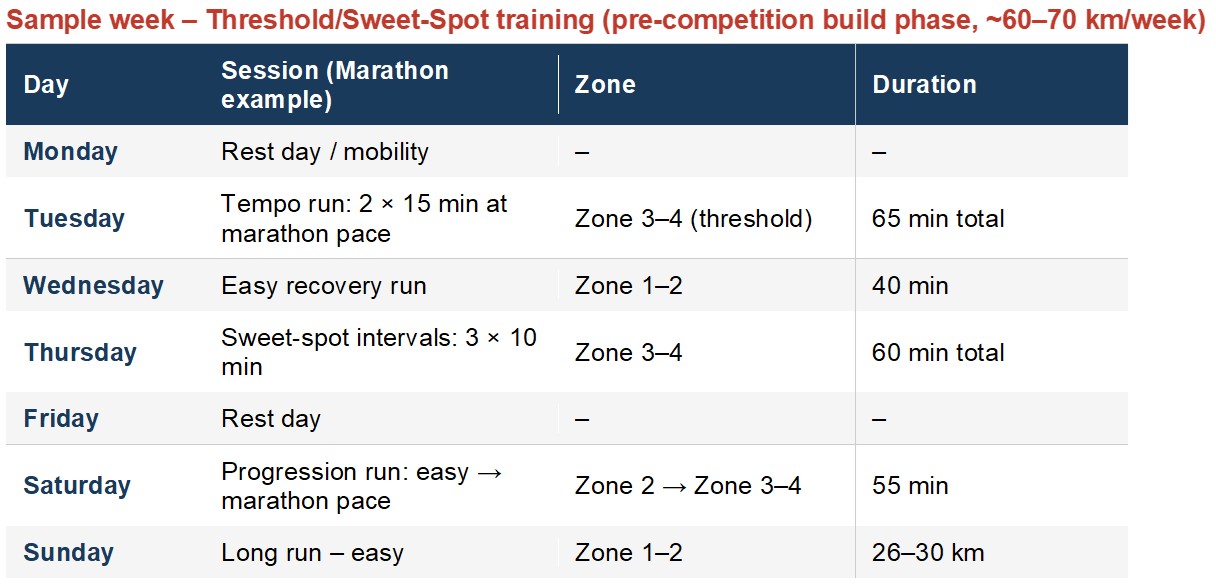
Two threshold or sweet-spot sessions per week is the maximum that makes sense for age-groupers. Everything else stays easy – Zone 1–2. The long Sunday run is not a third quality session, it’s aerobic accumulation. Example in marathon context; for cyclists and triathletes, replace the run sessions with equivalent bike or swim blocks.
For triathletes: threshold work ideally concentrates on the weakest or most race-critical discipline. If the bike is where most time is lost, prioritise that – and keep run and swim sessions easy that week.
Common Mistakes
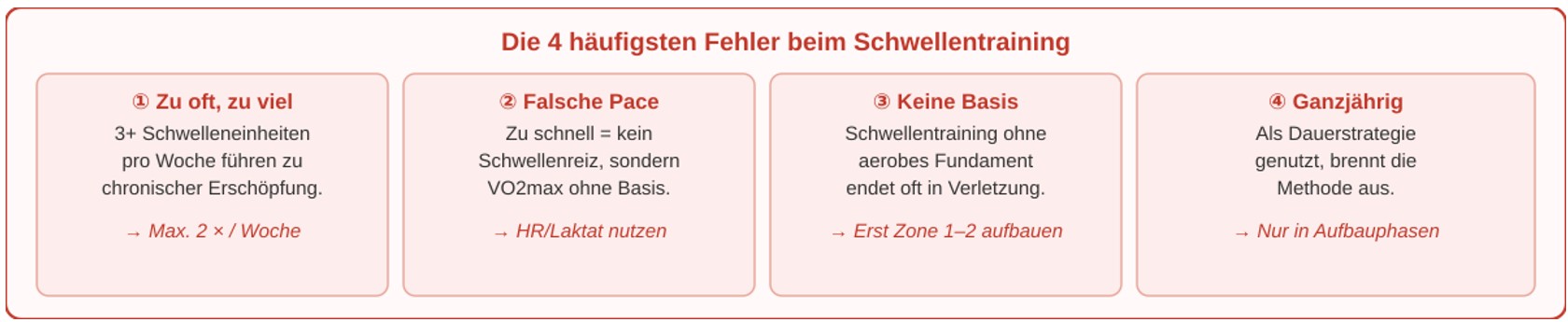
The most common mistake is simple overdosing: three or more threshold sessions per week produce no proportionally greater gains, but proportionally more exhaustion. The second most common mistake is wrong timing: threshold training during the base phase – without an aerobic foundation – is like lifting heavy without warming up.
When Threshold Training Makes Sense – and When It Doesn’t
Appropriate: In the 8–12 weeks before a race, when the aerobic base is already solid. As race-specific stimulus that simulates competition pace. For time-constrained athletes with four or fewer training sessions per week, where threshold work delivers the greatest stimulus per minute.
Not appropriate: As a year-round strategy. During the general base-building phase. Immediately after races or long loading blocks. For athletes who are already chronically fatigued or showing elevated injury risk.
Threshold training is the engine – but without a chassis, even the best engine won’t get you anywhere.
Conclusion
Threshold and sweet-spot training is an effective method with a clearly defined window: in the pre-competition build phase, on a solid aerobic foundation, dosed at a maximum of two sessions per week. As a complement to polarized base training – not a replacement for it.
In the next part of the series we look closely at HIIT training method.
Main Sources (Selection)
- Lactate Threshold Physiology – lactate kinetics, aerobic/anaerobic threshold, buffering capacity (foundational sports physiology literature, e.g. Veronique Billat, Alois Mader)
- FTP Concept (Functional Threshold Power) – the 88–93% Sweet Spot definition originates from the cycling training framework developed by Hunter Allen and Andrew Coggan in Training and Racing with a Power Meter
- Polarized Training – reference framework by Stephen Seiler (80/20 principle), against which threshold training is commonly contrasted
- Periodization Theory – classical base/build training phase logic (Tudor Bompa, Vladimir Issurin)
- Coaching Practice Experience – workout structure, dosage recommendations, and common athlete mistakes are based on applied coaching knowledge (implicitly: IRONCOACH practical experience base)