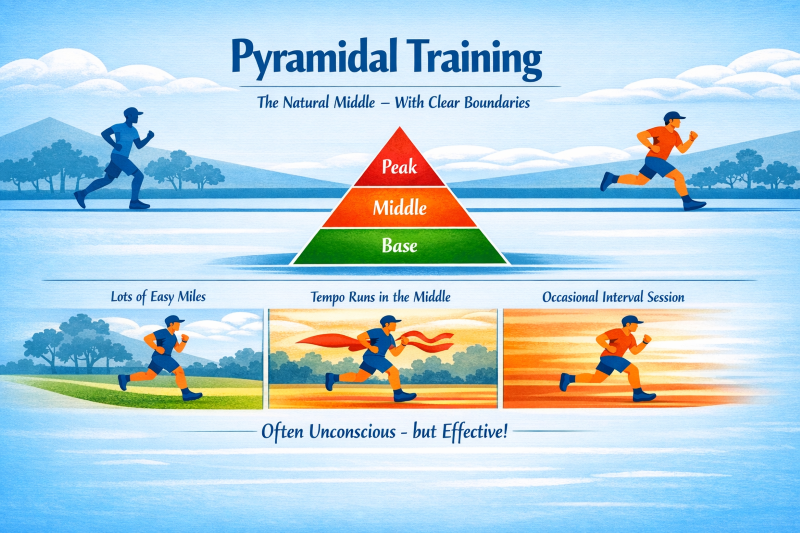
Pyramidal Training: The Natural Middle Ground – With Clear Limits
More base than threshold, more middle than polarized – why many athletes train pyramidally without knowing it, and what that means.
Further articles in this series: Overview of the Most Popular Training Methods | Part 1: Pyramidal Method | Part 2: Threshold and Sweet Spot Method | Part 3: HIIT Method | Part 4: Polarised Training Method | Part 5: The Norwegian Method
Anyone who has never thought consciously about intensity distribution is probably training pyramidally. Most kilometres easy, a meaningful share in the moderate range, occasional hard efforts on top – that’s the natural training structure that emerges when you simply run, ride or swim without strict zone targets. This makes pyramidal the most widespread – and simultaneously most underestimated – training philosophy in endurance sport.
Pyramidal is what most athletes train. The question is whether they do it deliberately – or by accident.
What Pyramidal Training Means
The intensity distribution follows a pyramid shape: the largest share in Zone 1–2, a substantial middle block in Zone 3, and a small peak share in Zone 4–5. A typical distribution sits at roughly 70% low, 25% medium, 5% high. This clearly distinguishes the method from polarized training, which deliberately avoids the middle, and from threshold training, which emphasises that middle block even further.
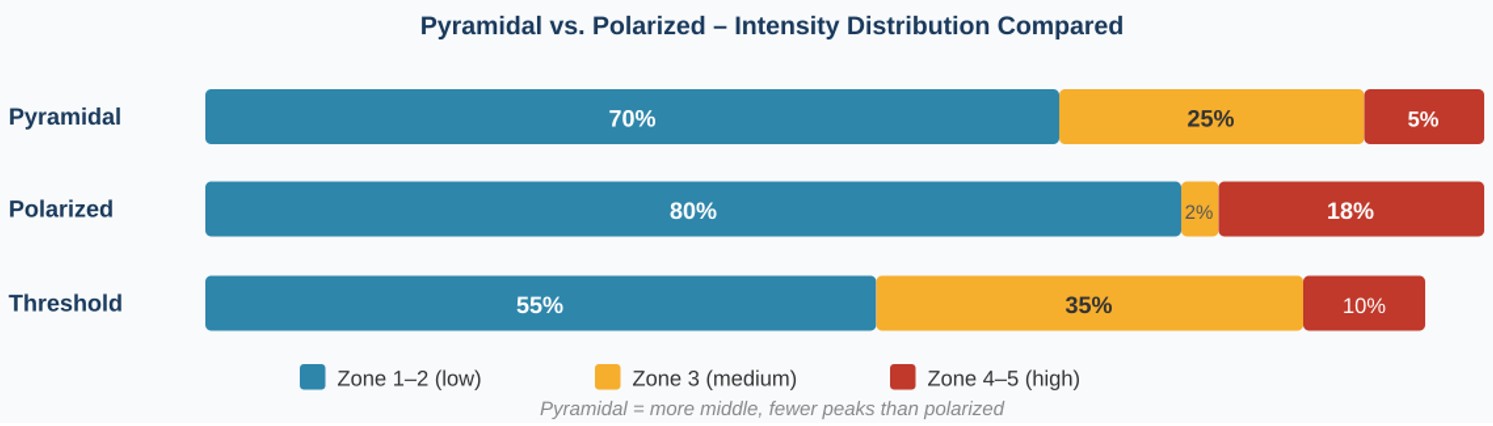
In practice, this means: base runs form the core of the week, complemented by one or two tempo runs in the half-marathon to marathon pace range – and occasionally a true interval session near VO2max. Pyramidal demands less intensity-control discipline than polarized because Zone 3 is permitted – but it still demands awareness that this middle block doesn’t grow unchecked.
Why It Works – and Where the Limits Are
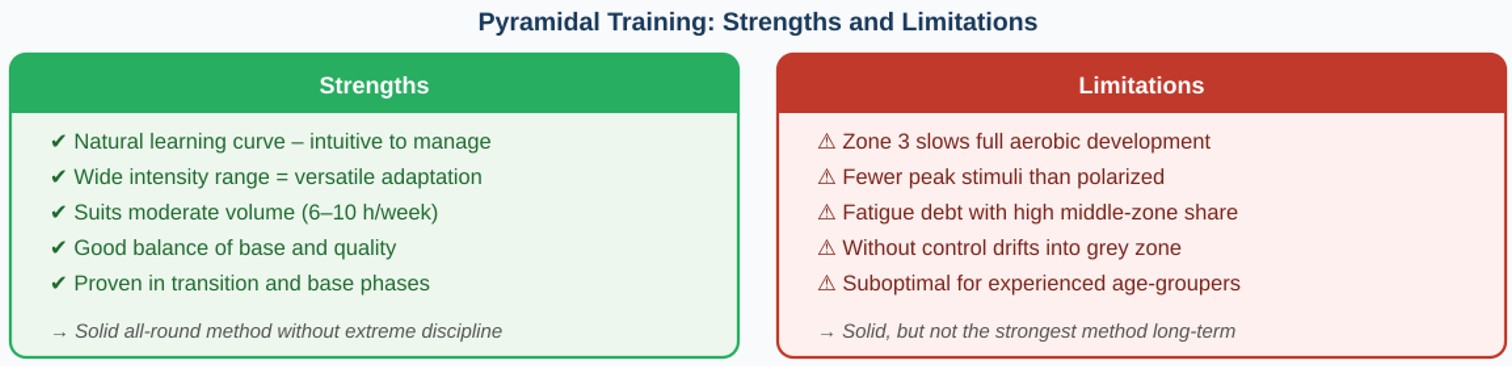
Pyramidal training develops a broad spectrum of endurance qualities: the aerobic base grows from high base volume, the lactate threshold is stimulated by Zone 3 work, and occasional high-intensity stimuli keep VO2max and neuromuscular efficiency alive. This makes the method particularly well-suited to moderate training volumes – the 6–10 hours per week that many engaged age-groupers can realistically sustain.
The limitation lies in depth of adaptation: too much time in Zone 3 risks the same grey-zone error as uncontrolled threshold training – fatigue accumulates without achieving clear high-intensity stimulus or full aerobic adaptation. And neglecting the peak share loses the VO2max stimulation that Zone 3 alone cannot replace.
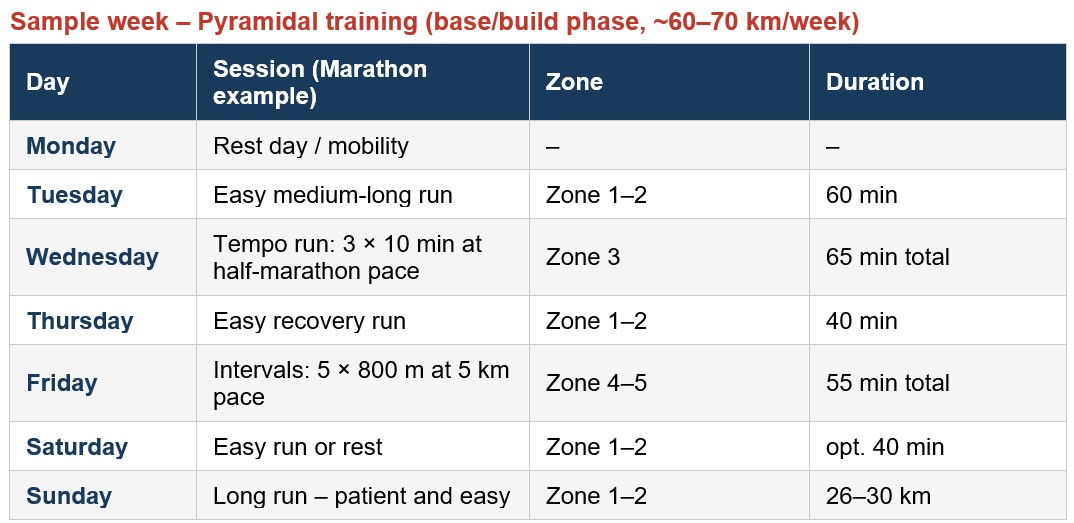
Weekly Structure in Practice
A pyramidal week typically contains one tempo or threshold session (Zone 3), one genuine quality session with high-intensity stimuli (Zone 4–5), and the rest in Zone 1–2 – including the long run at the weekend. Marathon example below; triathletes and cyclists apply the same logic with sport-specific sessions.
For triathletes, the pyramid spreads across all three disciplines: one Zone 3 session on the bike, one high-intensity run session, and the rest easy – swimming mostly in Zone 1–2 with technical focus.
Common Mistakes
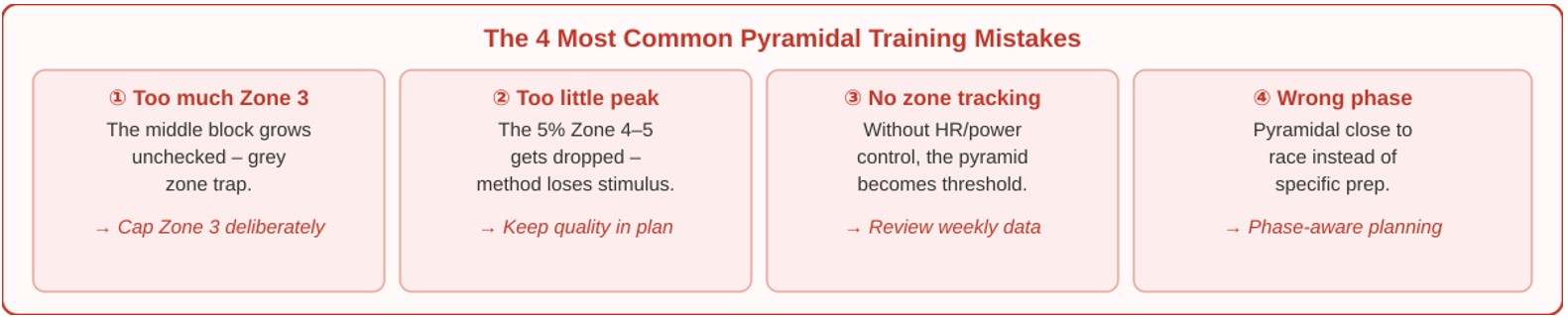
The biggest risk in pyramidal training is unconscious drift into the grey zone. Because Zone 3 is explicitly part of the method, the temptation grows to make base runs ‘a bit harder’. The result: the middle-intensity share swells to 35–40%, the method drifts toward pure threshold training – with all its downsides in terms of recovery and aerobic development. Weekly analysis of training zone data is not perfectionism – it’s necessary quality control.
When Pyramidal Makes Sense
Appropriate: In base and transition phases when volume is being built and no race-specific stimulus is yet needed. For beginners and returning athletes who don’t yet know structured zone training. For athletes in sports with naturally broad intensity ranges – swimrun or cross-triathlon, where variable terrain prevents strict zone control.
Less appropriate: As a year-round strategy for performance-oriented age-groupers. In the race-specific phase, where more targeted methods (polarized or threshold) set more precise stimuli. For highly experienced athletes who already have a solid aerobic base and now need stronger polarisation.
Pyramidal is a solid foundation – not an end goal. Those who want more will eventually need more discipline in intensity control.
Conclusion
Pyramidal training is the most honest method: it describes how most endurance athletes actually train – with a solid base, a conscious middle share, and occasional peak stimuli. That makes it accessible and well-suited to many phases of the training year. Those who want long-term performance gains will eventually need to sharpen the pyramid toward polarization.
In the next installment of the series, we cover the advantages and disadvantages of threshold training.
Sources (selection)
- TrainingPeaks Coach Blog: “Polarized vs. Pyramidal Training – Which is Better for Athletes?”
- Mission Triathlon: “Pyramidal Training vs. Polarized Training” (explanation + distribution)
- tri-mag.de: “Polarized or Pyramidal? What the Science Says” (meta-analysis & classification)
- Study (J Sports Sci Med, 2019): “Polarized and Pyramidal Training Intensity Distribution” (triathlon performance)
- SensAI Research Review (2026): Comparison of polarized, threshold, and pyramidal training
- TrainingPeaks (English): “Polarized vs. Pyramidal Training — Which is Better?”