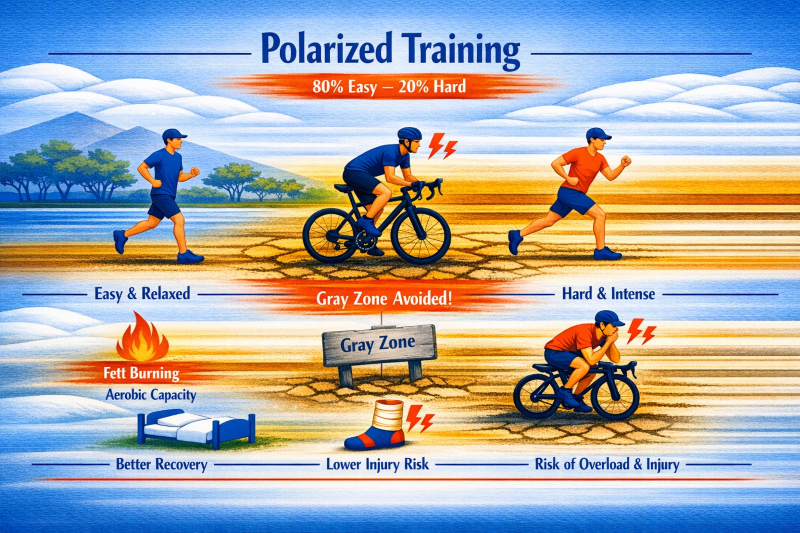
Polarized Training: The Smart Path to Greater Endurance Performance
80% easy, 20% hard – why this formula applies equally to runners, triathletes, cyclists and swimmers.
More articles in this series: Overview of the Most Popular Training Methods | Part 1: Pyramidal Method | Part 2: Threshold and Sweet Spot Method | Part 3: HIIT Method | Part 5: The Norwegian Method
It sounds almost too simple: train easy most of the time, go genuinely hard rarely. And yet polarized training is the philosophy that elite endurance athletes, current research, and experienced coaches across all disciplines agree on – running, cycling, swimming, triathlon, swimrun. The core principles are the same whether you’re preparing for a marathon, an Ironman, or a long-distance cycling event. The marathon serves as the reference example in this post; the principles apply equally across all endurance sports.
The sport is interchangeable. The principle is universal: 80% low, 20% high – avoid the grey zone consistently.
Why Two Extremes Beat the Middle
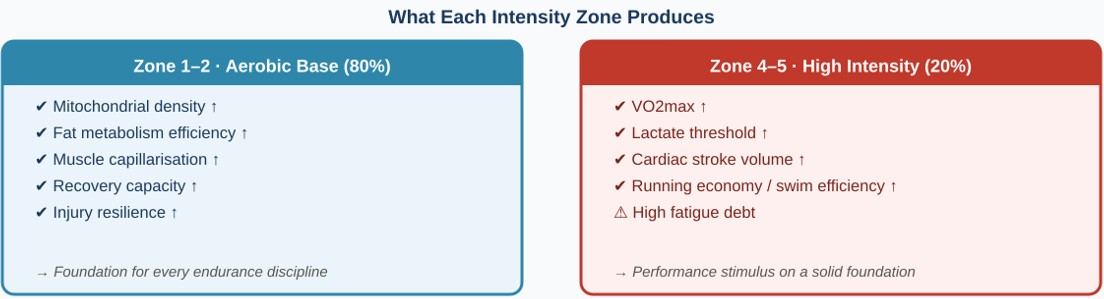
The aerobic system – the foundation of all endurance performance – is developed through volume at low intensity: mitochondrial density, fat metabolism, capillarisation. These adaptations only occur when intensity stays low enough. For peak stimuli, the body needs Zone 4–5, clearly above the lactate threshold: VO2max, cardiac output, sport-specific efficiency. The grey zone in between – Zone 3 – delivers neither fully, but accumulates fatigue. Researchers led by Stephen Seiler confirmed this across disciplines: running, rowing, cross-country skiing, cycling – those who train polarized achieve greater performance gains than those who focus mainly on threshold work.
Weekly Structure in Practice
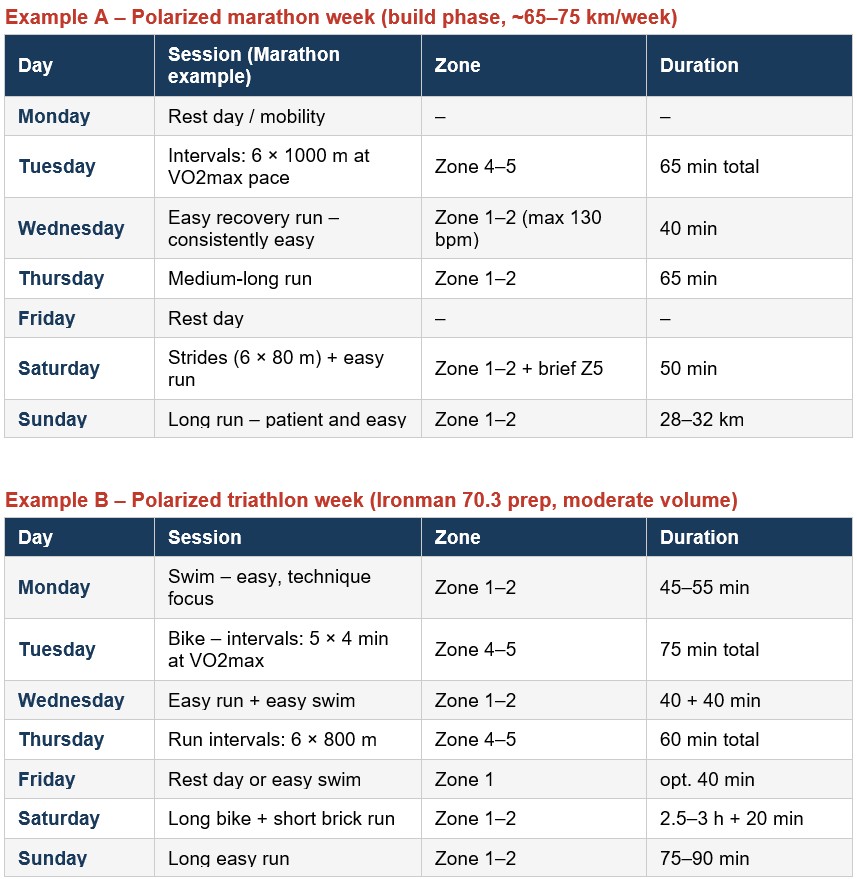
Maximum two hard sessions per week – everything else consistently easy. No ‘medium-hard’ compromise between recovery and quality. Two example weeks – one for marathon runners, one for
Common Mistakes
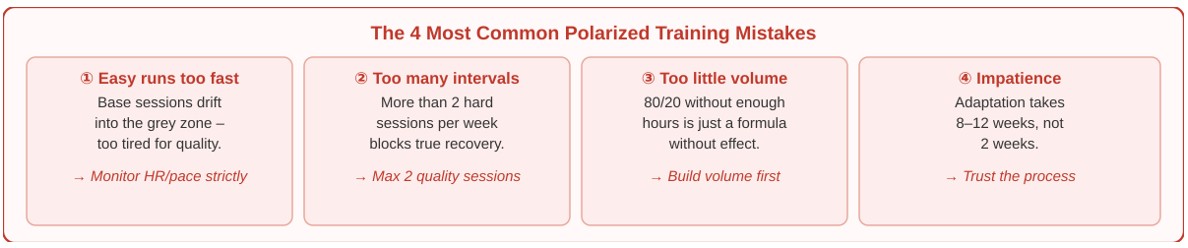
The most common mistake is structural and affects all sports equally: easy sessions are run too fast – often 30–60 seconds per kilometre above the optimal Zone 1–2 range, or in the wrong watt range on the bike. Heart rate or power measurement is not a luxury, it’s a tool. Triathletes face an additional challenge: with three disciplines, total intensity creeps in easily. ‘A bit intense’ in every discipline lands you systemically in the grey zone.
Why Polarized Is the Best Choice for Age-Groupers
The method protects against the most common mistake in amateur sport: the permanent grey-zone loop that produces neither performance nor recovery. Easy sessions can be done before work or after a long day without taxing the nervous system. Only the one or two quality sessions per week demand genuine freshness – and they get it, because the rest of the week is easy. The result: fewer injuries, better recovery, more sustainable progress.
For age-groupers, polarized training is above all one thing: permission to train easy – without guilt.
Conclusion
Polarized training is the distillation of decades of research and elite experience – across all endurance disciplines. Those who have the discipline to truly stay easy when it should be easy, and work genuinely hard when quality is called for, will train faster, more durably, and more healthily over the long term.
In the next part of the series we look at the Norwegian method. It can produce fantastic results, but is not really suited for age-groupers.
Main Sources
- Stephen Seiler – Leading figure in polarized training research; his studies on intensity distribution among elite endurance athletes (running, rowing, cross-country skiing, cycling) form the scientific foundation of this article.
- Stephen Seiler & Gøran Østerås Kjerland (2006) – “Quantifying Training Intensity Distribution in Elite Endurance Athletes: Is There Evidence for an ‘Optimal’ Distribution?” – Scandinavian Journal of Medicine & Science in Sports → Foundational publication on the 80/20 intensity distribution model.
- Stephen Seiler (2010) – “What Is Best Practice for Training Intensity and Duration Distribution in Endurance Athletes?” – International Journal of Sports Physiology and Performance → Frequently cited review paper on the polarized training method.
- Thomas Stöggl & Billy Sperlich (2014) – “Polarized Training Has Greater Impact on Key Endurance Variables Than Threshold, High Intensity, or High Volume Training” – Frontiers in Physiology → Experimental confirmation that polarized training outperforms threshold- and HIIT-based approaches.
- General exercise physiology concepts (implicit) – including mitochondrial density, fat metabolism, capillarization, VO2max, and lactate threshold; consistent with standard endurance training literature by experts such as Jack Daniels and Véronique Billat.