Which Method is Best for You?
Introductory article to a 5-part series
More articles in this series: Part 1: Pyramidal Method | Part 2: Threshold and Sweet Spot Method | Part 3: HIIT Method | Part 4: Polarised Training Method | Part 5: The Norwegian Method
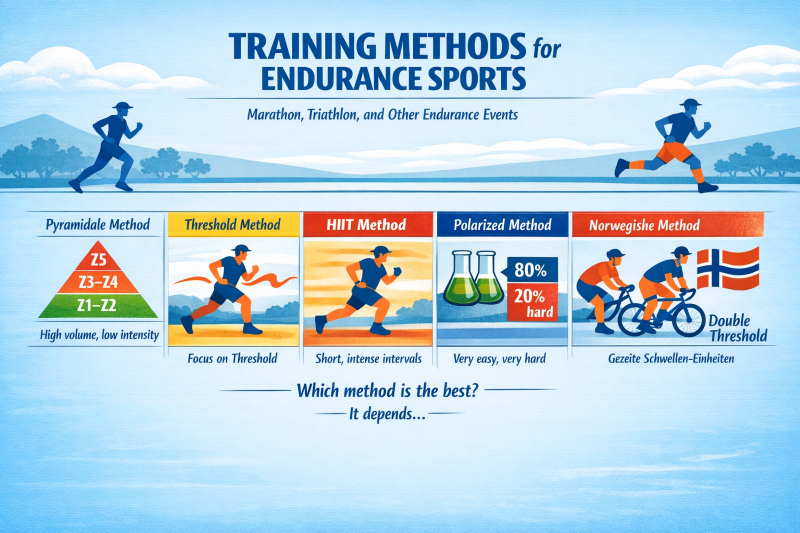
Anyone training for a marathon or other endurance events quickly realizes: there is no single perfect method. While some concepts emphasize high training volumes with many easy miles, others focus on intense intervals or precisely controlled threshold work. Newer approaches such as the Norwegian method are also gaining importance.
Despite different approaches, most successful concepts are based on the same physiological foundations. The main differences lie in how training intensities are distributed, how often hard sessions are performed, and how recovery is structured.
A commonly used reference is the 5-zone model:
-
- Z1: very easy / recovery
- Z2: easy / aerobic base
- Z3: moderate / tempo
- Z4: threshold / controlled hard
- Z5: very hard / VO₂max
Below are the most important training approaches. In the next parts of the series, these methods will be analyzed in detail.
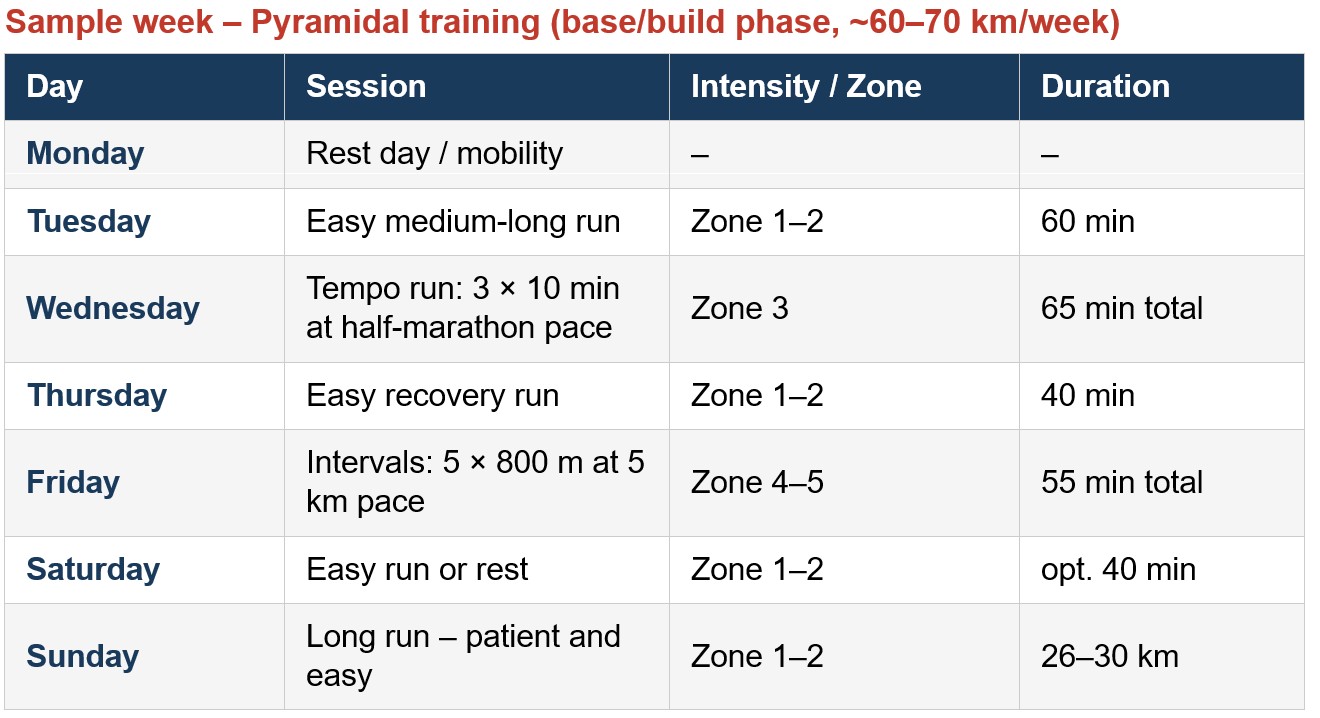
1. The Pyramid Method
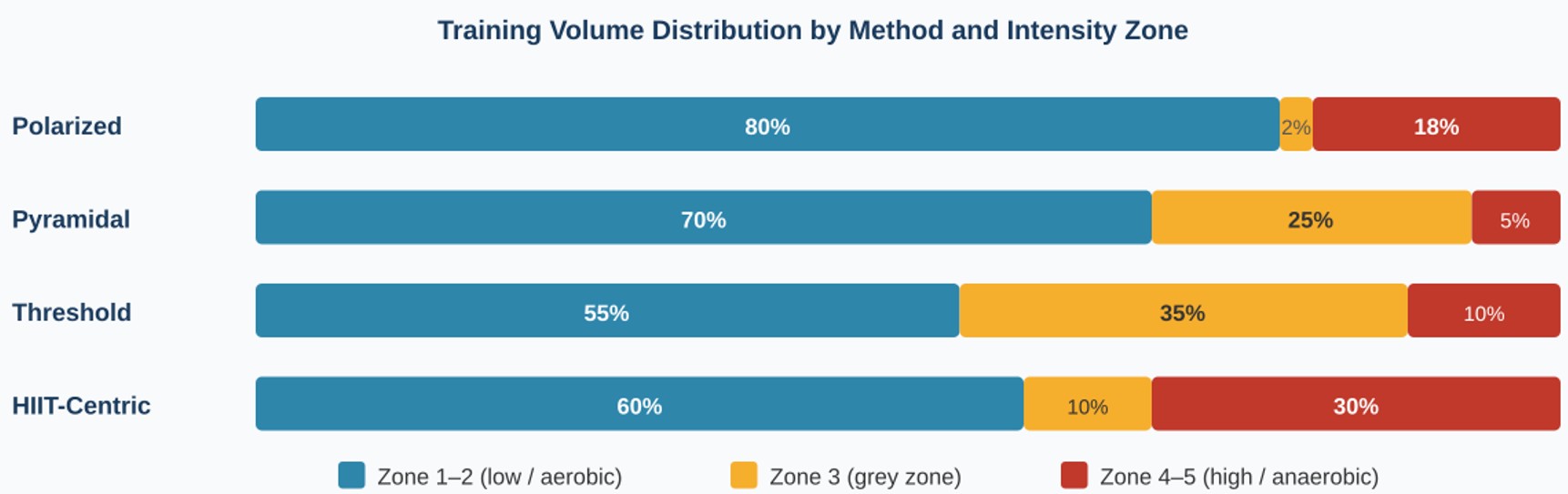
The pyramid method is a classic approach in endurance sports. It features an intensity distribution where most time is spent at low intensity, less in the middle range, and very little at high intensity.
Typical characteristics:
-
- High proportion in Z1–Z2
- Moderate proportion in Z3–Z4
- Low proportion in Z5
Unlike polarized training, this method deliberately includes regular work in the moderate intensity range. It is widely used by marathon runners, triathletes, and cyclists with high training volumes.
One advantage is that a lot of time is spent at race-specific intensity. Marathon runners, for example, benefit from regularly training at or slightly below race pace. However, the added load in the moderate intensity range can make recovery more difficult. Without proper control, athletes risk falling into the so-called “gray zone,” where training feels hard but does not provide optimal stimulus.
This method is especially suitable for athletes with ample training time and good tolerance to workload. In practice, elements from pyramidal, polarized, and threshold-oriented approaches are often combined.
2. The Threshold Method
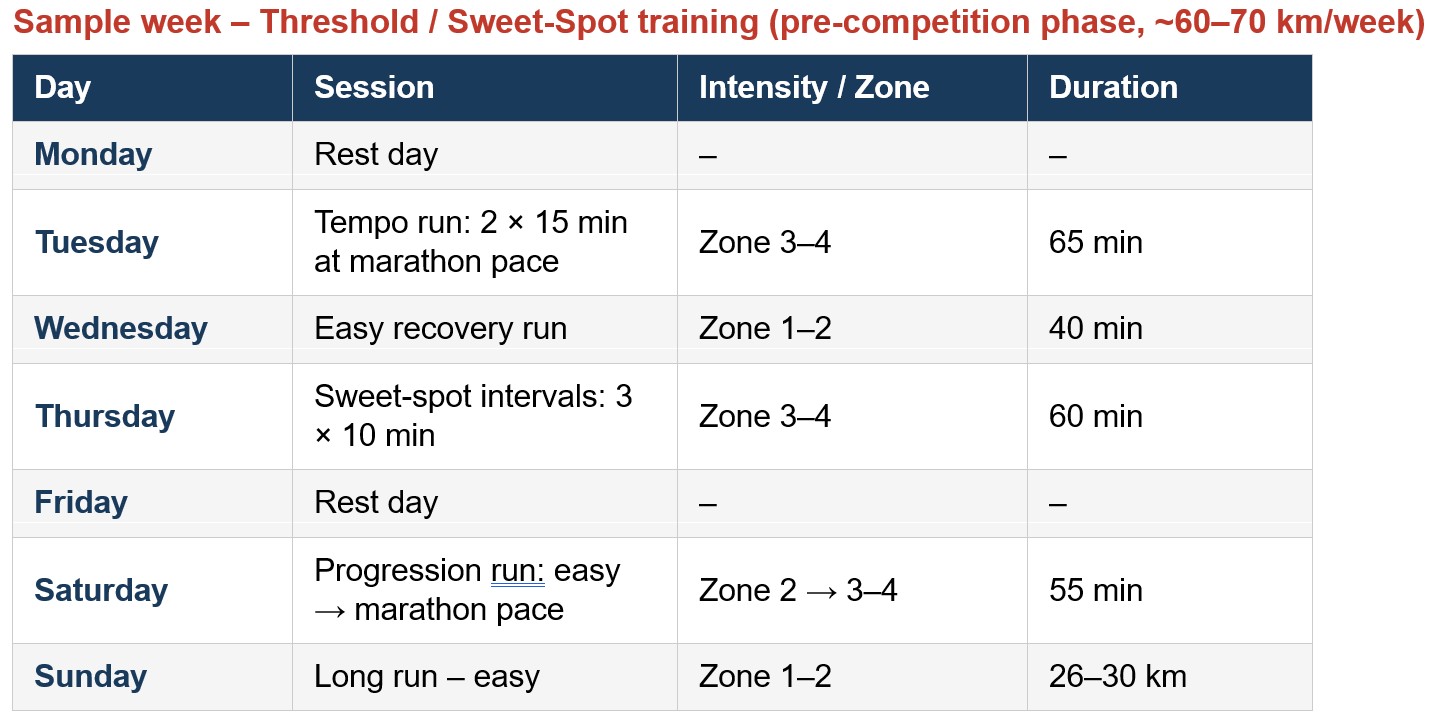
The threshold method focuses on the area around the anaerobic threshold—the point where lactate production and clearance are in balance. The goal is to maintain high speeds for longer periods.
Typical training elements:
-
- Tempo runs
- Longer intervals just below race pace
- So-called cruise intervals
The main emphasis is in Z3–Z4, supplemented by easy sessions.
This method is particularly relevant for ambitious marathon runners, as it directly targets race-specific demands. However, there is a risk of training too frequently in the moderate intensity range, which can lead to chronic fatigue if hard efforts and recovery are not clearly separated.
When applied correctly, threshold training can significantly improve performance—provided it is well dosed and integrated into a balanced overall plan.
3. The HIIT-Oriented Method
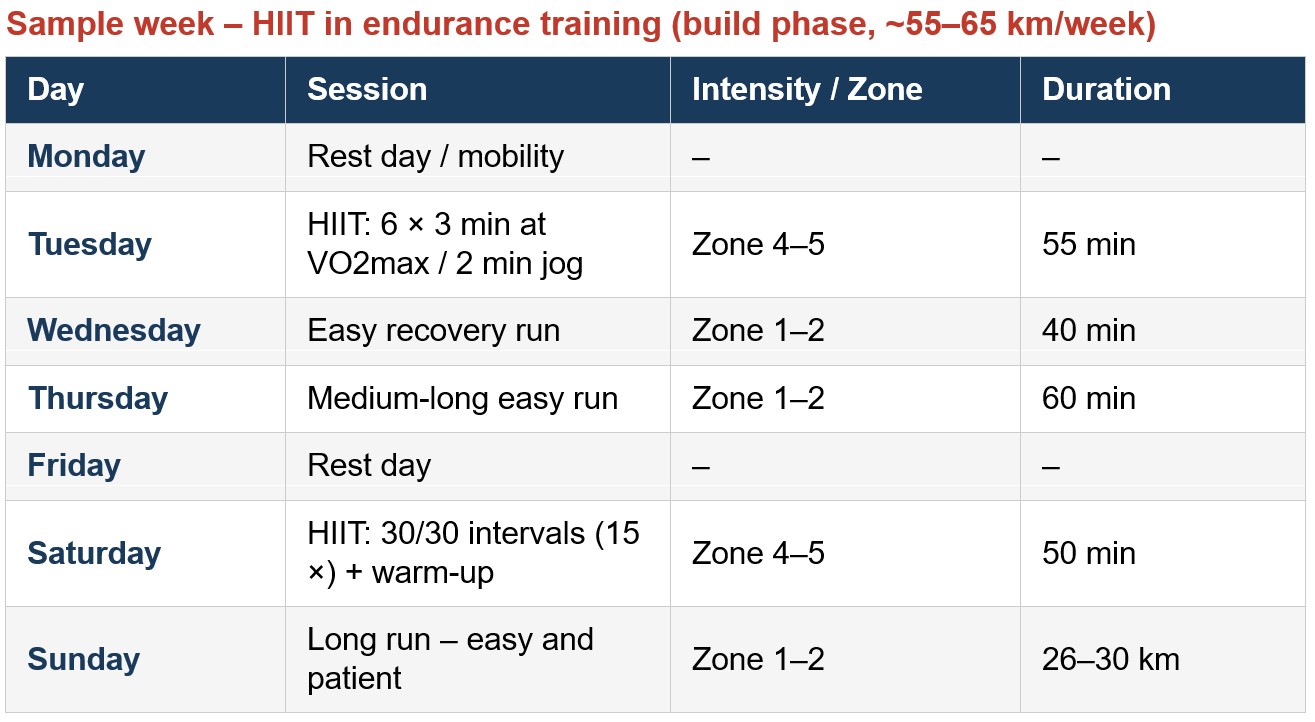
High-Intensity Interval Training (HIIT) is based on short, very intense efforts aimed at improving maximum oxygen uptake (VO₂max). Examples include short intervals, 400-meter repeats, or hill sprints.
Typical features:
-
- Efforts in Z5
- Very high intensity, short duration
- High training effect with relatively low time investment
Its biggest advantage is efficiency: strong performance stimuli can be achieved in a short time. However, it also increases the risk of injury and overuse. Muscles, tendons, and the nervous system are heavily stressed.
For marathon runners, HIIT alone is usually insufficient because it lacks specific endurance. However, in combination with other methods, it can be a powerful addition, particularly for improving VO₂max and running economy.
4. The Polarized Method
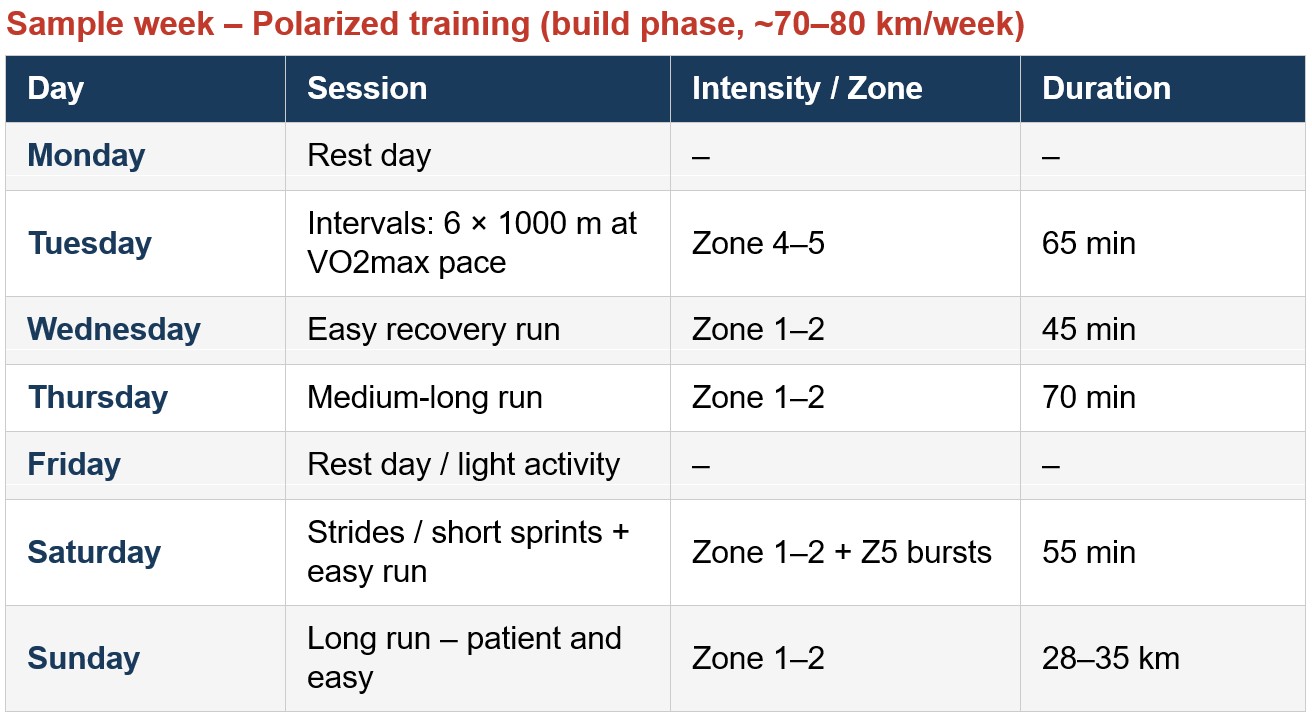
The polarized training method is one of the most well-researched concepts in endurance sports. Its principle is simple: most training is very easy, a small portion is very intense, and the middle range is largely avoided.
Typical distribution:
-
- ~80% in Z1–Z2
- ~20% in Z4–Z5
- Little to no training in Z3
The idea is to make high training volumes sustainable by keeping easy sessions truly easy. The hard sessions provide targeted performance stimuli.
This method is especially suitable for:
-
- Marathon and triathlon training
- Long-term performance development
- Athletes with limited recovery capacity
Recreational athletes benefit in particular because the structure is clear and compatible with everyday life. It also reduces the risk of unintentionally training too often in the inefficient moderate range.
5. The Norwegian Method
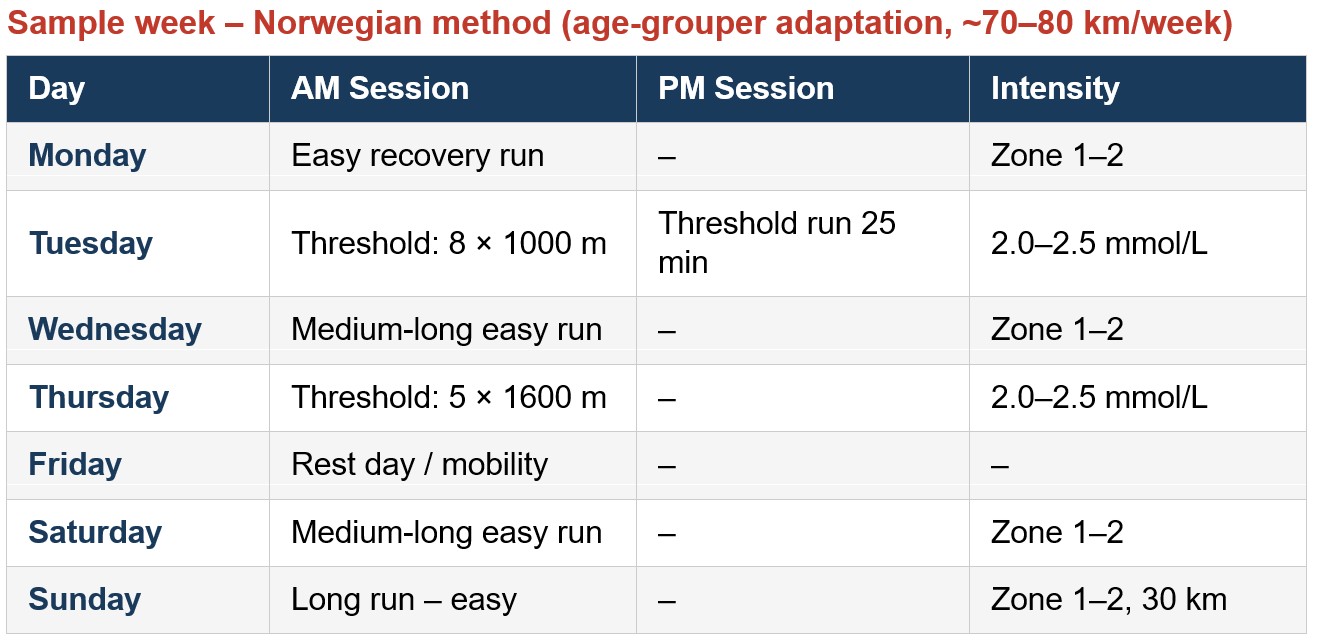
The Norwegian method became well known through elite athletes such as the Ingebrigtsen brothers and triathletes like Kristian Blummenfelt. It combines high training volume with precisely controlled threshold efforts.
Key characteristics:
-
- Frequent threshold intervals
- Precise control using lactate measurements
- “Double threshold days” with two sessions per day
The focus is not on maximum intensity, but on controlled effort just below the fatigue limit. The goal is to repeatedly perform high-quality sessions.
In practice, this approach works very well at the elite level. For many amateur athletes, however, it is difficult to implement because it is time-consuming and often requires lactate testing. Nevertheless, it has strongly influenced modern training concepts, especially in terms of precise intensity control.
Which Method Is Best?
The honest answer: it depends…
The optimal training strategy depends on several factors:
-
- Fitness level and experience
- Available time
- Recovery capacity
- Injury susceptibility
- Personal goals
However, some general patterns emerge:
- High volume is effective but time-intensive
- Threshold training is powerful but fatiguing
- HIIT is efficient but rarely sufficient on its own
- The Norwegian method is promising but complex
Overview
Why Ironcoach Favors the Polarized Method for Age-Group Athletes
For most age-group athletes, the polarized method offers an excellent balance between performance development, recovery, and everyday practicality.
Many athletes unknowingly train too often in the moderate intensity range — too fast for true recovery but too slow for maximum performance gains. This is exactly where polarized training provides a solution.
Those who consistently:
-
- Keep easy sessions truly easy
- Apply hard efforts strategically
- Allow sufficient recovery
can achieve significant improvements—even with limited training time.
For this reason, the polarized method is considered particularly effective for ambitious recreational athletes who need to balance training with work and family life.
Endurance sports teach an important lesson: Nothing meaningful is built instantly.
In the next article:
A detailed look at pyramidal training – physiology, structure, common mistakes, and adaptations for beginners and advanced athletes.
Main Sources (Selection)
- Stephen Seiler – research on polarized training and intensity distribution in endurance sports
- Norwegian School of Sport Sciences – scientific studies on threshold and endurance training
- Jakob Ingebrigtsen and the Ingebrigtsen training model as an example of the Norwegian method
- Arthur Lydiard – volume-based base training in endurance sports
- Joe Friel – training management in triathlon and endurance sports
- Scientific studies on VO₂max, threshold, and HIIT training in marathon and endurance contexts
- Practical approaches from modern marathon and triathlon coaches in elite and age-group sports