Few myths in endurance sport are more persistent than this one: as you get older, you simply have to accept that performance declines. Train less, demand less, rest more. Those who believe this underestimate both the adaptability of the human body and what sports science has established over the past two decades.
Research on masters athletes, generally defined as athletes aged 40 and above, paints a more nuanced and considerably more encouraging picture. Yes, age-related changes are real. But regular, intelligent training slows these changes dramatically. The data shows that a well-trained 55-year-old endurance athlete can physiologically be close to an average trained 30-year-old.
What does this mean in practice for training, recovery, injury risk, and long-term health? And how does a training week for an ambitious masters athlete actually differ from that of a younger age-group athlete targeting the same finish time?
1. Physiological Differences: What Actually Changes
The most significant measurable performance marker in endurance sport is maximal oxygen uptake, or VO₂max. It declines with age — by roughly 5 to 10 percent per decade in trained athletes, and somewhat faster after the age of 60. The main drivers are a declining maximum heart rate, a slightly reduced cardiac stroke volume, and a gradual loss of muscle mass.
What many athletes overlook, however, is that a lower maximal heart rate does not automatically mean worse endurance performance. Many masters athletes offset this decline through years of accumulated training efficiency, refined race tactics, and improved movement economy. The body learns to do more with less.
From around age 40, a gradual process of sarcopenia begins: muscle mass declines, explosive power decreases, and type-II muscle fibres are lost disproportionately. This is why masters athletes tend to struggle most with explosive efforts — accelerations, hill surges, finishing sprints — while pure aerobic endurance holds up remarkably well for much longer.
Tendons and connective tissue also change over time: they become less elastic, collagen turnover slows, and joint range of motion often decreases. This affects running economy, raises the risk of injury during sudden spikes in training load, and extends the recovery time needed after intense sessions.
2. Recovery: The Most Important Practical Difference
One area where masters athletes differ most fundamentally from younger athletes, is recovery. Research shows that repair processes run more slowly, restoration of muscle strength takes longer, and the nervous system needs more time to return to full readiness after hard sessions.
What a 25-year-old processes in 24 hours may require 48 to 72 hours for a 50-year-old. This is biology. And ignoring it does not make training harder; it makes it less effective.
Sleep becomes substantially more important with age: it is the single most powerful lever for hormonal balance, immune function, and muscle repair outside of training itself. Many experienced coaches report that sleep quality is one of the strongest performance factors for masters athletes.
Nutrition follows a similar pattern. Adequate protein, consistent energy availability, and sufficient carbohydrate intake become more critical, not less. Many masters athletes, counterintuitively, eat too little rather than too much. The consequences show up as delayed recovery, increased susceptibility to illness, and stagnating performance. Here you can download a sample weekly nutrition plan with suggestions for healthy eating, both for mixed diets and for vegetarians.

3. Training: The Same Stimuli, Applied More Carefully
The most common mistake among ambitious masters athletes is not overtraining, it is the wrong conclusion drawn from ageing: “I’m getting older, so I’ll just train easy from now on.” Sports science suggests something different.
Successful masters athletes retain VO₂max work, threshold sessions, and interval training. The training principles remain the same. What changes is the density of load: slightly less total volume, more rest days, and longer recovery windows between hard sessions. The polarised training model with high volume at low intensity, targeted work at high intensity, minimal time in the middle, fits masters athletes particularly well, because it builds recovery into the structure by design.
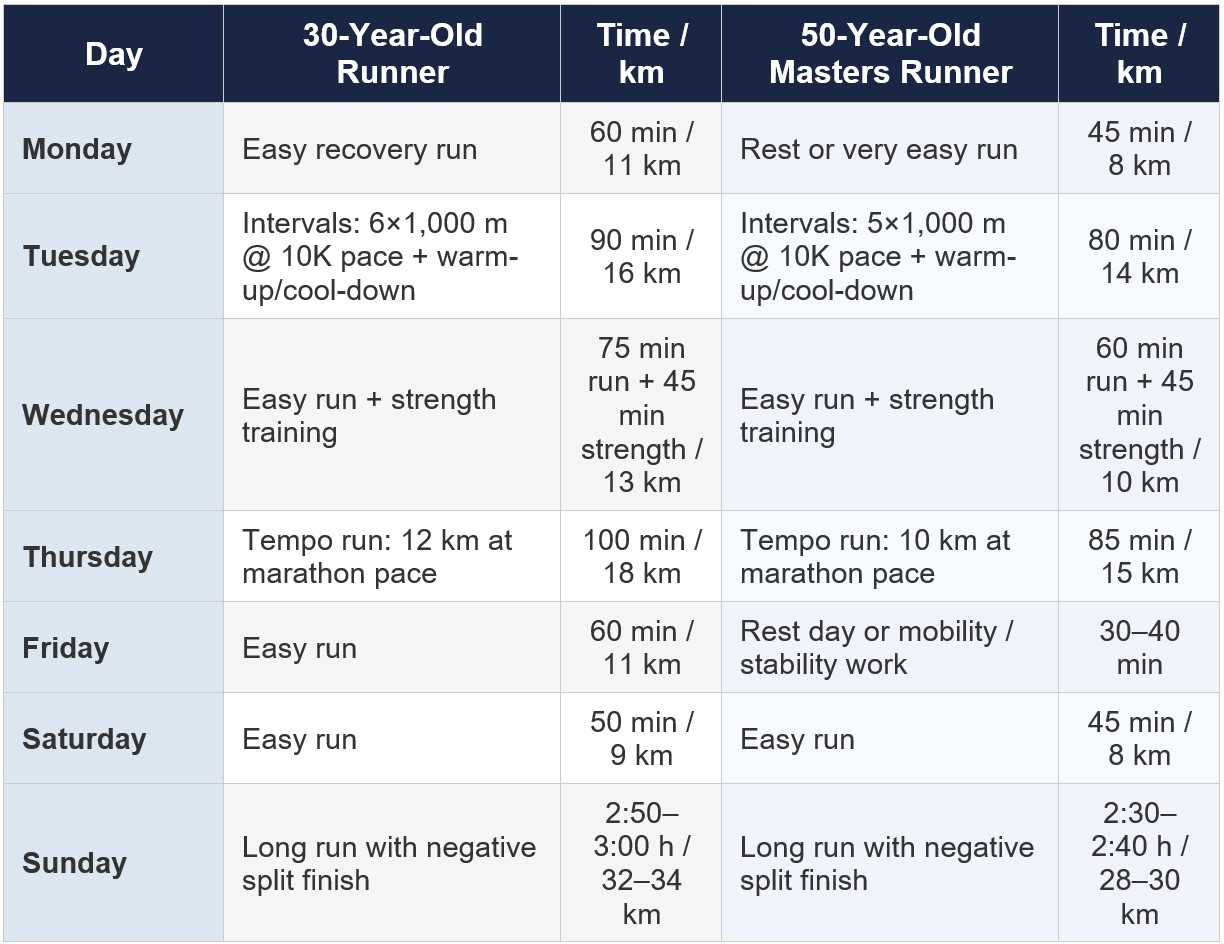
A 50-year-old runner targeting a 3:30 marathon typically trains 10 to 20 percent less in running volume than a 30-year-old with the same goal, not 20 to 30 percent less, as is often assumed. The difference is made up with greater emphasis on strength work, mobility, and structured recovery.
Strength training is no longer optional for masters athletes, it is foundational. It preserves muscle mass, supports bone density, improves running economy, and reduces injury risk. Two to three sessions per week is now the standard recommendation across sports science literature.
Sample Peak-Phase Week (Goal: Marathon 3:30 h)
Peak phase, 4–6 weeks before race day
Weekly Volume Comparison
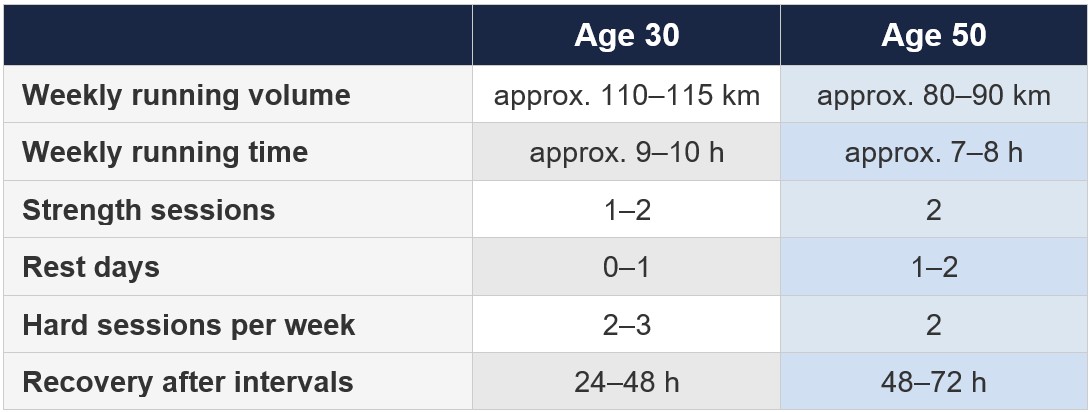
The table shows that the difference lies less in the type of training than in its dosage. Masters athletes need the same stimuli — but more space to absorb them.
4. Injury Risk: Not Fragile, But More Sensitive
Masters athletes are not more fragile than younger athletes but they respond more sensitively to sudden spikes in training load and recover more slowly from overuse. Common problem areas include the Achilles tendon, plantar fascia, hamstrings, and knees. Not because the body is failing, but because changes in tendon elasticity, reduced strength reserves, and slower healing processes compound each other.
The greatest risk factor is probably training like a 25-year-old, recovering like a 55-year-old. Most injuries among masters athletes arise not from too much training, but from too much intensity with too little recovery. Understanding this makes it possible to reduce injury risk significantly without abandoning performance goals.

5. Health and Quality of Life: The Strongest Case of All
Beyond the performance discussion, science presents a compelling picture: Endurance training ranks among the most effective interventions available for long-term health and longevity. Trained individuals show lower all-cause mortality, significantly reduced cardiovascular disease rates, lower rates of type 2 diabetes, and reduced cancer mortality.
There are also well-established links to better cognitive performance, reduced risk of dementia, and improved memory function in older age. The brain benefits at least as much as the body.
Perhaps the most important concept here is not lifespan but healthspan – the duration of physical capability, mobility, and independence. Endurance training measurably extends this window. A 55-year-old who trains consistently usually moves with the functional capacity of an untrained 35-year-old.
Conclusion: Age Is a Variable, Not a Verdict
Masters sport does not mean compromising on ambition, it means making smarter compromises on dosage. Intensity stays; volume is adjusted; recovery becomes a ‘training discipline’. Strength work, sleep, and nutrition carry more weight. And successful masters athletes who understand this do not train less purposefully than they did at 25, they just train more intelligently.
The age-related changes in performance are real. But they are not inevitable. With consistent training, intelligent load management, and genuine respect for recovery, they can be slowed significantly across decades, and the healthspan extended considerably.
Hauptquellen (Auswahl)
- Tanaka, H. & Seals, D.R. (2008). Endurance exercise performance in Masters athletes: age-associated changes and underlying physiological mechanisms. Journal of Physiology, 586(1), 55–63.
- Fitzgerald, M. (2014). 80/20 Running: Run Stronger and Race Faster by Training Slower. New American Library. – Grundlage für das polarisierte Trainingsmodell.
- Wroblewski, A.P. et al. (2011). Chronic exercise preserves lean muscle mass in masters athletes. The Physician and Sportsmedicine, 39(3), 172–178.
- Lepers, R. & Cattagni, T. (2012). Do older athletes reach limits in their performance during marathon running? Age, 34(3), 773–781.
- American College of Sports Medicine (ACSM) Position Stand (2009). Exercise and Physical Activity for Older Adults. Medicine & Science in Sports & Exercise, 41(7), 1510–1530.
- Moran, D.S. et al. / Kenney, W.L. (2019). Physiology of Sport and Exercise (7th ed.), Kapitel zu Masters Athletes und Aging. Human Kinetics.