
The Right Balance of Volume and Intensity for Performance, Fitness and Long-Term Health
There is one single physiological measure that tells you more about your endurance performance, your health, and even your life expectancy than almost any other: maximal oxygen uptake, or VO2max. Understand it, train it deliberately, and you gain a real edge — not just on race day, but far beyond.
What is VO2max?
VO2max describes how much oxygen your body can take in and use per minute per kilogram of bodyweight. The unit is ml/kg/min. The higher this value, the more energy your body can produce aerobically — and the faster and longer you can move before tipping into oxygen debt.
Think of VO2max as the size of your engine. A bigger engine means more potential — but how efficiently you run it is determined by the rest of your training.
VO2max Reference Values at a Glance
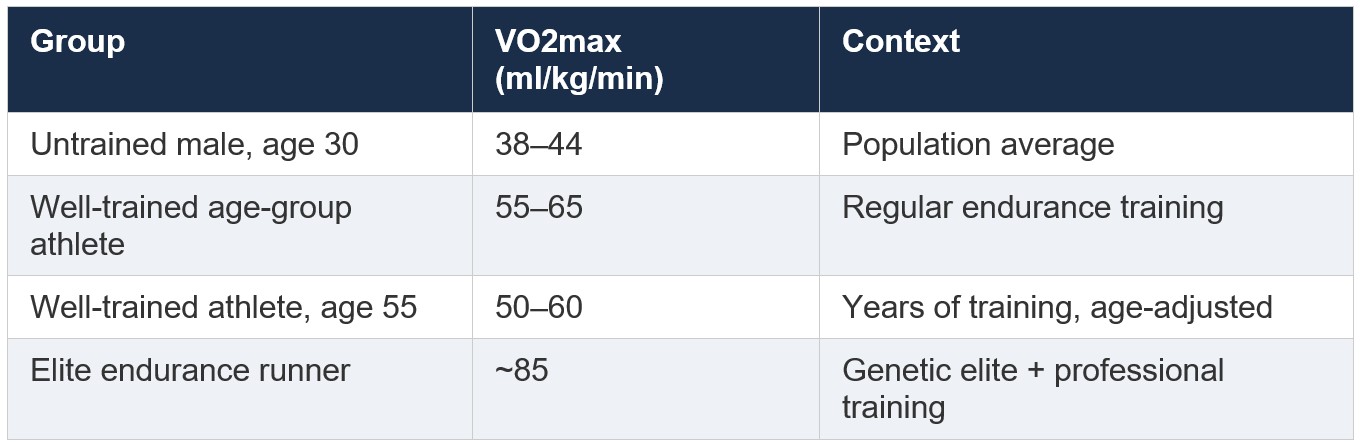
A well-trained 55-year-old endurance athlete who trains consistently and intelligently can maintain VO2max values of 50–60 ml/kg/min — often matching the level of an untrained 30-year-old, and sometimes well above it. Without training, VO2max declines roughly 1% per year from age 30. Consistent endurance training slows this decline considerably.
“Regular endurance training can significantly slow the age-related decline in VO2max — effectively turning back the biological clock by 10 to 20 years.”
VO2max and Life Expectancy: More Than Just Sport
Decades of research are unequivocal: VO2max is one of the strongest independent predictors of all-cause mortality and cardiovascular disease — stronger than blood pressure, cholesterol, or BMI.
Studies consistently show that people with a high VO2max not only live longer, but stay healthier and more functionally capable for longer. Every increase of 3.5 ml/kg/min (one MET) reduces the risk of death by approximately 13%. Moving from the lowest fitness category to the next cuts your risk roughly in half.
That is not a small effect. It is one of the most powerful health interventions available — and it costs not pills, but running shoes.

How Do You Improve VO2max?
VO2max can be improved through two complementary pathways — and both belong in a well-structured training plan.
Pathway 1: Volume — Long, Easy Sessions
The first and most underestimated pathway is aerobic base training. Long, easy runs at moderate intensity (Zone 1–2) work deep in your physiology: they increase cardiac stroke volume, improve capillarisation of the muscles, raise mitochondrial density, and increase blood volume and haemoglobin mass — all direct building blocks of VO2max. For beginner and moderately trained athletes, meaningful VO2max gains through volume alone are well documented, without a single interval session. Your Sunday long run is not just a foundation for harder work — it is itself a VO2max tool.
Pathway 2: Intensity — Intervals and Tempo Work
The most direct and time-efficient pathway runs through high-intensity sessions that push the body close to its maximal oxygen uptake. For well-trained athletes whose aerobic base is largely developed, intensity provides the decisive additional stimulus. The most effective formats include:
- Long intervals at 95–100% VO2max intensity (e.g. 4–6 × 3–5 min with short recovery)
- Short high-intensity intervals — e.g. the 30/30 method: 30 sec hard, 30 sec easy
- Tempo runs at lactate threshold, building the foundation for VO2max work
- Hill repeats: joint-friendly, high cardiovascular demand
The 80/20 Principle: Combining Both Pathways
Research shows that the best results come not from maximum intensity, but from a smart combination of both pathways like with polarized training. Around 80% of training should take place in the easy aerobic zone — where volume and recovery reinforce each other. The remaining 20% of targeted intensity delivers the decisive additional stimulus. VO2max interval sessions are powerful, but they require recovery. Too much leads to stagnation or injury — too little leaves potential on the table.
When Is the Best Time: Before or During the Marathon Plan?
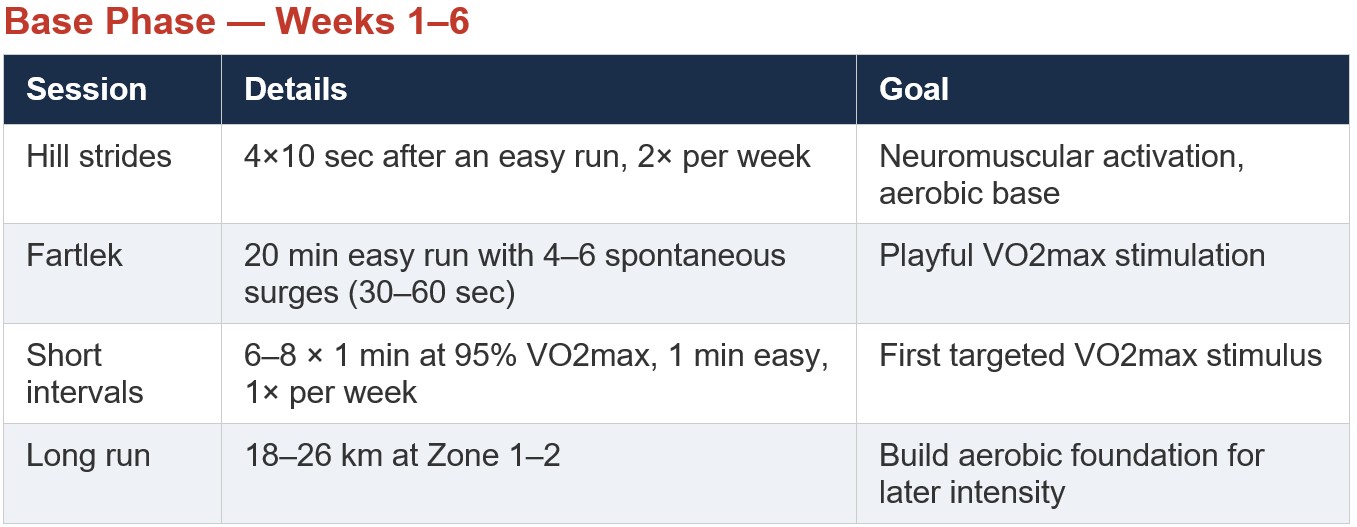
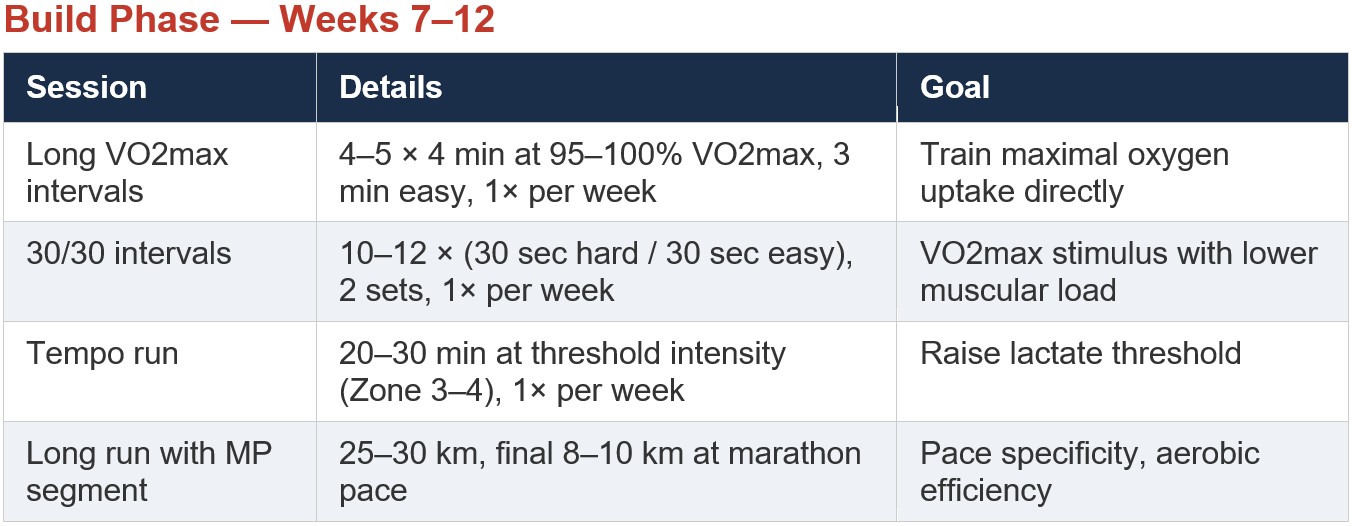
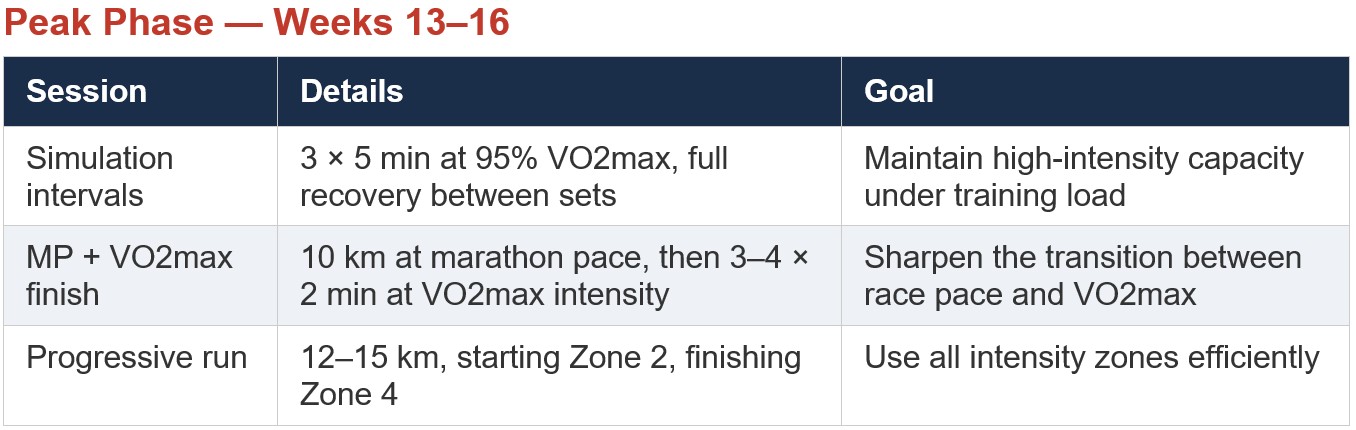
An 18-week marathon plan is not a flat line — it follows a clear phase structure with four distinct blocks: Base, Build, Peak, and Taper. Each phase has its own objective, and each phase has its own role for VO2max work — or a deliberate absence of it.
The short answer: VO2max is best developed during the training plan, embedded within the phase structure — not front-loaded into an isolated block beforehand. The reason: VO2max gains require time and a functioning aerobic foundation. Stacking intense intervals in the weeks before a marathon plan risks carrying fatigue into the plan exactly when it picks up momentum. The smarter approach is to integrate VO2max stimulation progressively — light touches in the base, increasingly specific work through the build and peak phases.
Taper Phase — Weeks 17–18
During the taper you cut training volume significantly — but you don’t disappear from the track. VO2max work still belongs in the taper, just in a sharply reduced form. The goal is no longer adaptation, but sharpness: the capacity you have built over 16 weeks should arrive at the start line fresh and ready to fire. Short, crisp strides and one controlled mini-interval session keep the system at operating temperature. Athletes who do nothing in the taper risk feeling sluggish and flat on race day. Those who do too much arrive fatigued. The sweet spot: less, but sharp.
Rule of thumb: intensity stays, volume is halved (week 17) and halved again (week 18). What has not been trained will not be caught up now.
Practical Guidelines for VO2max Training
- VO2max intensity corresponds roughly to your 5-km race pace, or an RPE of 8–9 out of 10.
- Never schedule two hard VO2max sessions back-to-back. Allow at least one easy day in between.
- During recovery weeks (every 3–4 weeks), reduce or remove VO2max sessions entirely.
- Sleep well, eat well — VO2max gains are made during recovery, not during the session itself.
- VO2max intensity corresponds roughly to the upper end of Zone 4 or the start of Zone 5 (LTHR classification).
Conclusion: Train Your Engine
VO2max is not just a number for elite athletes. It is a window into your health, your performance capacity, and your biological age. As an age-group endurance athlete, you can improve it meaningfully — and in doing so, run faster, ride longer, and live healthier for longer.
Integrate VO2max sessions intelligently into your training plan, respect recovery, and build progressively. Your engine will reward you — at the start line and far beyond it.
Main Sources (Selection)
- Bassett & Howley (2000) — Medicine & Science in Sports & Exercise — Foundational work on VO₂max as a limiting factor in endurance performance; a key reference in exercise physiology.
- Laukkanen et al. (2016) — JAMA Internal Medicine — Long-term study on the link between cardiorespiratory fitness (VO₂max) and overall mortality as well as cardiovascular risk.
- Seiler & Tønnessen (2009) — International Journal of Sports Physiology and Performance — Foundational paper on the 80/20 polarization principle; explains why combining volume and intensity is superior.
- Milanović et al. (2015) — Sports Medicine — Meta-analysis on HIIT and VO₂max improvements; demonstrates the effectiveness of high-intensity intervals compared to moderate endurance training.
- Tanaka & Seals (2008) — Journal of Physiology — Study on the age-related decline in VO₂max and how endurance training slows this process in master athletes.