Blood markers in endurance sports: measure, understand, train better
Anyone who trains regularly puts the body through demands that show up not only in performance data but also in blood work. Many athletes know their threshold power, their heart rate zones, or their FTP down to the watt, yet have no idea when they last had their iron profile tested. This is exactly where a well-planned blood panel comes in: it shows whether training, nutrition, and recovery are in balance, or whether a deficit is quietly building up that will eventually hold back performance or negatively affect your health.
Regular blood testing is not an end in itself, and it is no substitute for medical care, but it is a valuable tool for catching trends early. A single value often says little; only the trend across several measurements provides real insight. That is why it is worth it to treat blood testing as a fixed part of season planning, much like a performance test, just with a needle instead of an ergometer.
The Key Markers at a Glance
Not every blood test is equally relevant for endurance athletes. A complete blood count is useful, but there is a handful of markers that are especially meaningful for athletic performance and long-term health. The iron profile usually sits at the center, because latent iron deficiency, even without overt anemia, can impair oxygen transport capacity and therefore directly affect aerobic performance. Alongside this, the complete blood count (hemoglobin, hematocrit, erythrocytes) provides important clues about oxygen-carrying capacity, while ferritin, as a marker of stored iron, often drops weeks before a clinically noticeable deficiency appears.
Vitamin D deserves special attention, since it influences not only bone metabolism but also immune function and muscle recovery and is frequently low or even deficient during the winter months in Central Europe.
Vitamin B12 and folate status are relevant for blood formation and the nervous system, particularly for athletes with reduced meat intake or a plant-based diet. Thyroid values (especially TSH) provide information about metabolism and can shift out of balance under chronic overload or unusual fatigue.
The profile is rounded out by CRP (C-reactive protein) as an inflammation marker, which can hint at systemic inflammatory processes or overtraining syndrome, as well as by creatine kinase (CK), which reflects muscular load and recovery after intense training blocks or races.
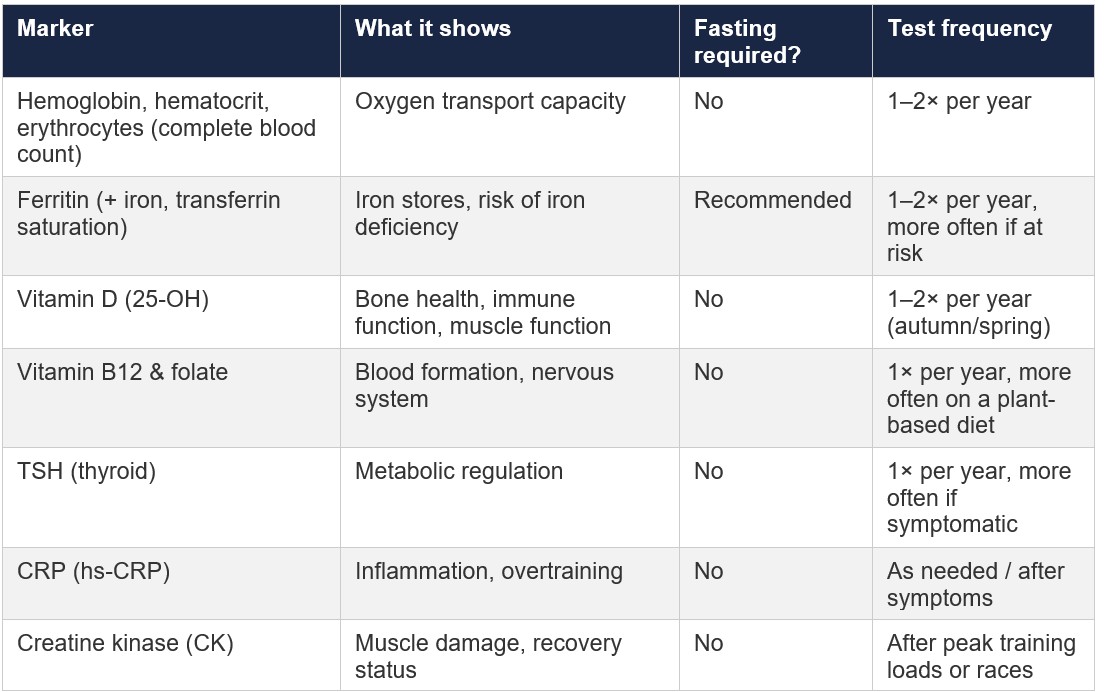
A fasting blood draw, typically 10–12 hours without food, is mainly useful for the iron profile, since food intake can slightly distort these values. For the other markers, fasting is not strictly necessary, but it is practical from an organizational standpoint, since many labs offer a complete panel from a single blood draw.
Do Women Need Different Tests than Men?
For women, the iron profile is particularly important, since monthly menstruation means additional iron loss, and iron deficiency is significantly more common among female endurance athletes than among men. The target ferritin range is also often set higher for female athletes than the plain “normal value” for the general population would suggest. In men, the focus tends to be more on markers of muscular load (CK) and occasionally testosterone, particularly when there are signs of overtraining, performance stagnation, or lack of recovery. Both sexes benefit from regular checks of vitamin D and B12 levels, as these are frequently borderline regardless of sex.
Do Athletes have Different Target Values Than the General Population?
Endurance athletes differ from the standard reference population in several respects. Ferritin should ideally sit above 50–60 µg/L for athletes, while the lab reference range often labels anything from 15–20 µg/L as “normal”, a value that already represents a performance risk for endurance athletes. Hemoglobin can also be lower due to the so-called “athlete’s anemia” phenomenon (plasma volume expansion from training), without this being a real problem, context is key here. Resting heart rate and certain cholesterol values are often more favorable in well-trained athletes than in the general population average, which should be taken into account when interpreting lab values, so as not to unnecessarily intervene on a value that is in fact healthy.
Additional Tests for Master Athletes
As athletes age, several additional parameters become more important. These include an extended lipid panel (LDL, HDL, triglycerides, possibly Lp(a)) to assess cardiovascular risk, fasting blood glucose or HbA1c for early detection of insulin resistance, and regular kidney and liver values, since these organs compensate less well for training load with age. For men over 40, a testosterone check can also be useful, while women in perimenopause should consider checking hormone levels (estrogen, FSH) together with vitamin D and bone metabolism markers, as osteoporosis risk increases. An annual resting ECG or cardiology evaluation is also advisable for master athletes with high training loads, even though this is not a classic “blood test.”
Which Lifestyle Measures Support Optimal Blood Values
The good news is that most of these values can be effectively influenced through nutrition, sleep, and training management. Adequate sleep (seven to nine hours) supports red blood cell production and the immune system, while chronic sleep deprivation can raise CRP and cortisol. An iron-rich diet combined with vitamin-C-rich foods for better absorption, regular sun exposure or targeted vitamin D supplementation during the winter months, and sufficient energy intake (avoiding the chronic energy deficit known as RED-S) are central building blocks. Thoughtful training periodization with clear recovery phases also reduces the risk of elevated inflammation markers and CK values.
The best remedy for poor blood values is usually not a supplement, but better training and sleep planning and balanced nutrition.
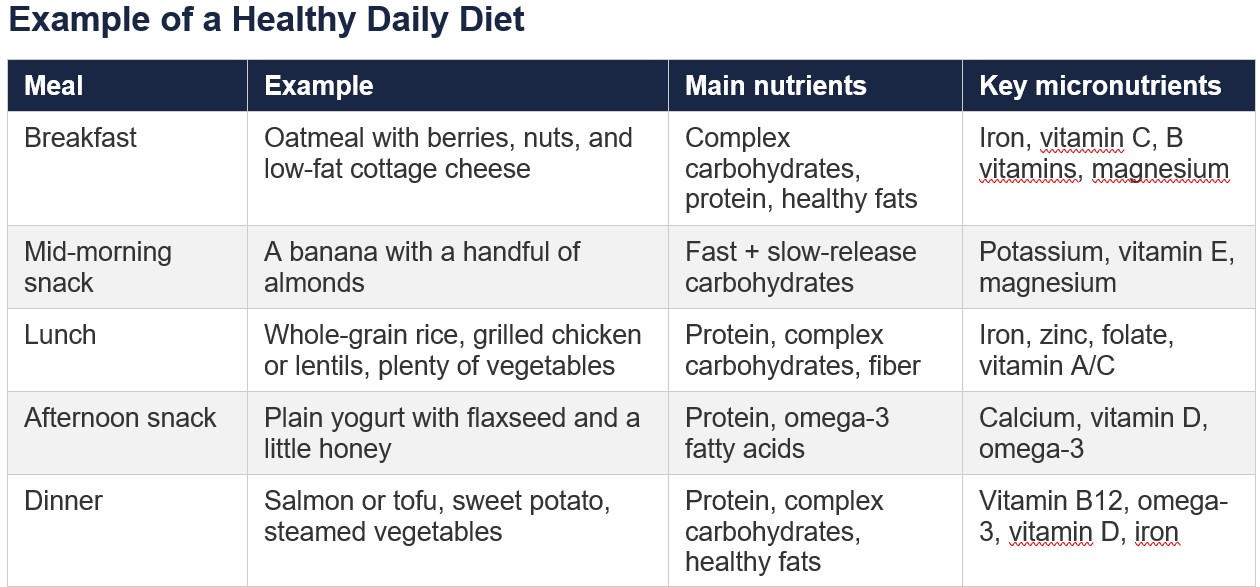
Here you can download a sample weekly nutrition plan with suggestions for healthy eating, both for mixed diets and for vegetarians.

Shoud I Take Dietary Supplements?
For most healthy people, dietary supplements offer far less benefit than advertising promises. They are often excellent business for manufacturers, whose industry generates billions, while the health benefits of many products are barely supported by scientific evidence.
However, there are some that are well supported by science. Vitamin D3 (often combined with vitamin K2) is useful when a deficiency has been confirmed, especially during the winter half of the year in Central Europe. Iron supplements should only be taken when a deficiency has been confirmed and after medical evaluation, since unnecessary iron intake also carries risks (oxidative stress, iron overload). Omega-3 fatty acids (EPA/DHA) show positive effects on inflammation markers and recovery in studies. Vitamin B12 is especially relevant for athletes following a plant-based diet. Magnesium can help in cases of confirmed deficiency or frequent cramping but should not be taken in high doses purely “just in case.”
As a general rule: supplements do not replace a balanced diet, they complement it where a genuine need has been identified.
Conclusion
A well-designed blood panel is far more than a snapshot for endurance athletes. It is an early warning system for overtraining, deficiencies, and health risks that would otherwise only become apparent through declining performance. Athletes who have their values checked once or twice a year can react early, adjust their training, recovery and nutrition, and ultimately train both healthier and more effectively over the long term.
Main Sources (Selection)
- Mountjoy M, Ackerman KE, Bailey DM, et al. 2023 International Olympic Committee’s (IOC) consensus statement on Relative Energy Deficiency in Sport (REDs). Br J Sports Med. 2023;57(17):1073–1097.
- USA Triathlon. Iron Strength: What Endurance Athletes Should Know About Iron Deficiency Anemia and Ferritin Screening.org
- The IRONy in Athletic Performance. PMC, National Library of Medicine (NIH), PMC10708480.
- DellaValle DM, Haas JD. Impact of Iron Depletion without Anemia on Performance in Trained Endurance Athletes at the Beginning of a Training Season. Int J Sport Nutr Exerc Metab. 2011;21(6):501–506.
- Mielgo-Ayuso J, et al. Iron Deficiency in Athletes: Insights for Sports Nutrition. European Society of Medicine (esmed.org).
- World Health Organization (WHO). Reference values for hemoglobin and ferritin concentrations defining anemia and iron deficiency.