Why Wrong Pacing on the Bike Will Ruin your Run
Picture the scene at kilometre 15 of the Ironman run. An athlete — well-trained, well-prepared, genuinely capable of a strong marathon — is shuffling. Legs gone. Energy gone. The race that looked so promising out of T2 has unravelled, and there are 27 kilometres still to go.
Ask that athlete what went wrong and the answer is almost always some version of the same thing: “I felt so good on the bike.”
That feeling is the problem. Feeling good on the bike at Ironman pace can be a warning sign rather than a reassurance. The energy you spend above your sustainable threshold on the bike does not simply slow you down on the bike — it is borrowed directly from the run. And in long-course triathlon, the run always collects the debt.
The bike leg doesn’t ruin your run in the final kilometres. It ruins it in the first hour, when everything still feels fine.
Why over-pacing the bike is so easy — and so common
The bike leg creates a perfect set of conditions for over-pacing. You feel fresh coming out of the swim. Your legs are rested from the taper. The course is rolling away in front of you, and the early kilometres feel effortless. Other athletes are passing you, which creates the natural impulse to respond.
The physiological reality is invisible in the moment. Riding at 80–85% of your functional threshold power (FTP) for six hours feels very different from riding at that intensity for 45 minutes in training. The cumulative cost accumulates silently. Glycogen stores deplete faster. Muscle damage compounds. The neuromuscular system begins to fatigue in ways that don’t show up until you start running.
The cardiovascular system is particularly deceptive. Heart rate lags behind power output, particularly early in the ride when adrenaline is elevated and the body is running on freshness. An athlete who targets heart rate alone in the first 90 minutes of the bike is routinely riding significantly harder than they realise.
The metric that matters: intensity factor
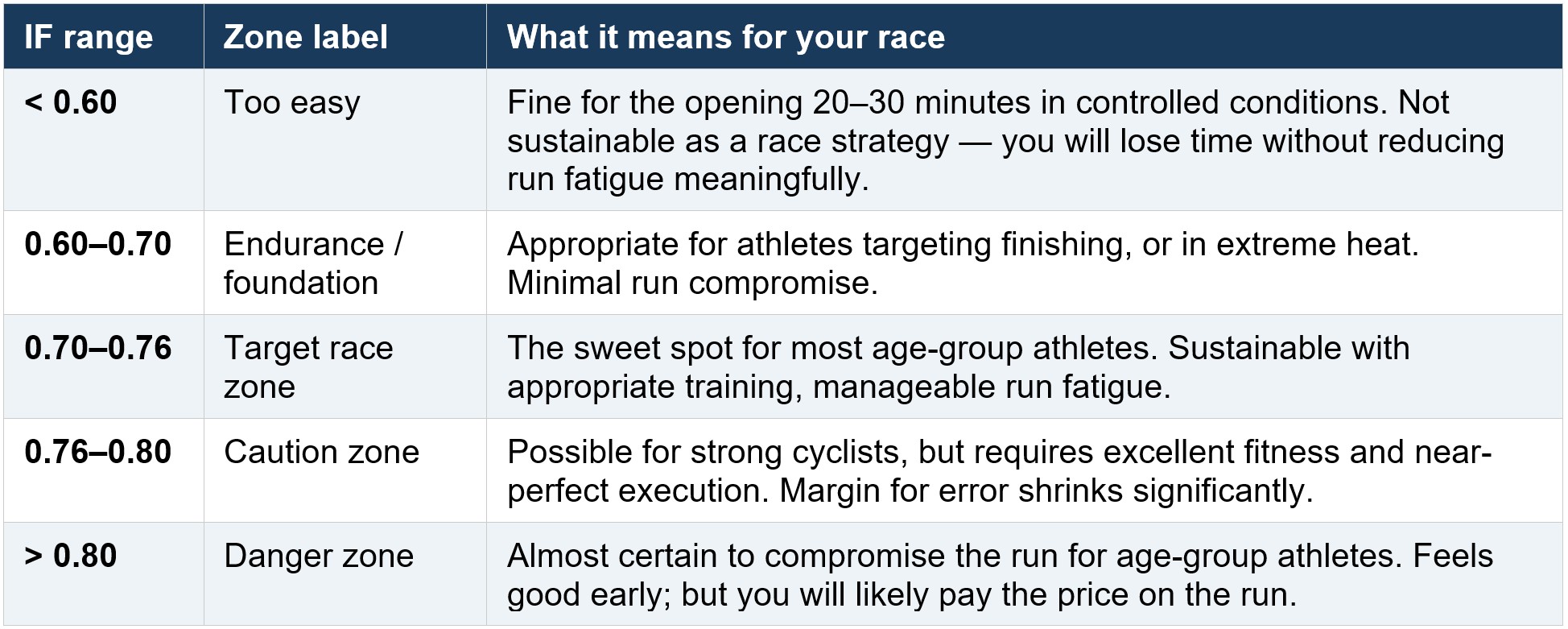
Power is the most reliable real-time measure of bike pacing. Unlike heart rate, power responds immediately and doesn’t lie. The key metric for Ironman bike pacing is Intensity Factor (IF) — your normalised power for the ride expressed as a proportion of your FTP. An IF of 1 means your threshold power or pace.
Research and decades of long-course data converge on a clear target range for age-group athletes: an IF of between 0.70 and 0.76. Below 0.70 and you are likely leaving time on the course; above 0.76 and you are progressively increasing the risk of a compromised run, with that risk rising sharply the further above that ceiling you go.
If you don’t train and race with a power meter, heart rate is your next best guide — but it requires more discipline to use effectively. Your Ironman bike heart rate should sit comfortably below your lactate threshold heart rate throughout, typically in the range of 65–75% of maximum, with the lower end of that range in the first 90 minutes. Any sustained drift above that range before the halfway point of the ride is a signal to ease back, regardless of how good you feel.
The hills problem
Variable terrain is where bike pacing falls apart for most athletes. The instinct on a climb is to maintain speed, which means surging power well above target. The instinct on a descent is to recover — but recovery on a descent is passive, and the power spike on the climb has already happened.
Normalised power accounts for this variability, which is why it is the correct metric to track rather than average power. But the practical pacing principle is simpler: ride the hills easier than feels right. If a climb feels comfortable, you are probably still going too hard. The correct sensation on an Ironman climb is one of deliberate restraint — other athletes pulling away from you, your power holding steady, your breathing controlled.
Experienced long-course athletes often describe the correct bike effort as “almost boring.” That is exactly right. If the bike feels exciting, you are racing too hard.
Wind, heat, and the importance of perceived effort
Power and heart rate are both compromised by environmental conditions in ways that a single fixed target cannot accommodate. In high heat, heart rate will run higher for the same power output as cardiac output is diverted to thermoregulation. In a strong headwind, maintaining target power may require a significant increase in perceived effort. In a tailwind, target power may feel disproportionately easy — which can create false confidence that leads to over-riding later in the ride.
Perceived exertion — specifically, how hard the effort feels relative to your experience of that sensation in training — is a valuable third input alongside power and heart rate. All three should be broadly consistent. If power is on target but perceived effort feels high and heart rate is elevated, the right response is to reduce power, not to hold the number. The goal is to arrive at T2 having spent your available energy budget wisely across the entire race, not to hit a power target on the bike while incurring costs elsewhere.
What a well-paced bike feels like
This is worth naming explicitly, because it feels counterintuitive until you have experienced it. A correctly paced Ironman bike leg should feel easy for the first two hours. It should feel controlled and sustainable through the middle third. Only in the final 40 to 50 kilometres should you begin to feel the effort meaningfully — and even then, you should feel confident rather than desperate.
Arriving at T2 with legs that feel genuinely good is not a sign that you have under-performed on the bike. It is a sign that you have set up a strong run. The proof arrives in the back half of the marathon, when athletes who over-rode are walking and you are still running.
A few practical markers of a well-paced ride:
- You are passed by athletes in the first 60 minutes who you overtake again in the final 30km of the bike or on the run
- Your average pace or power in the second half of the ride is equal to or greater than the first half
- You leave T2 feeling like you could run — not like running is the last thing you want to do
- Your run split is within 10–12 minutes of your standalone marathon or half marathon equivalent pace
The single adjustment that changes everything
If there is one tactical change that will improve more Ironman performances than any other, it is this: in the first 30 minutes of the bike leg, ride easier than you think you need to.
Not slightly easier. Noticeably easier. Let athletes go. Watch your power number. Ignore your speed. The first 30 minutes sets the tone for the entire day. Starting conservatively does not cost you time in any meaningful sense — the energy you preserve in those opening kilometres pays compound returns across the final 60km of the bike and the entire marathon.
Ironman is a race of accumulation. Fitness, preparation, nutrition, and pacing all accumulate across the day. So does fatigue — and the bike is where most athletes unknowingly accumulate far more of it than they intended.
Train the patience to pace it right. The run will take care of itself.
References (selected)
-
- Allen H, Coggan A. Training and Racing with a Power Meter. VeloPress.
- Coggan AR, Allen H. Quantifying training stress with normalized power, intensity factor, and training stress score. Journal of Strength and Conditioning Research.
- Laursen PB, Rhodes EC. Factors affecting performance in an ultraendurance triathlon. Sports Medicine.
- Hausswirth C, Brisswalter J. Strategies for improving performance in long-duration triathlon: pacing, energy, and fatigue. Sports Medicine.