Gravel Biking: The Perfect Mix of Endurance Training, Adventure, and Chilled Cycling
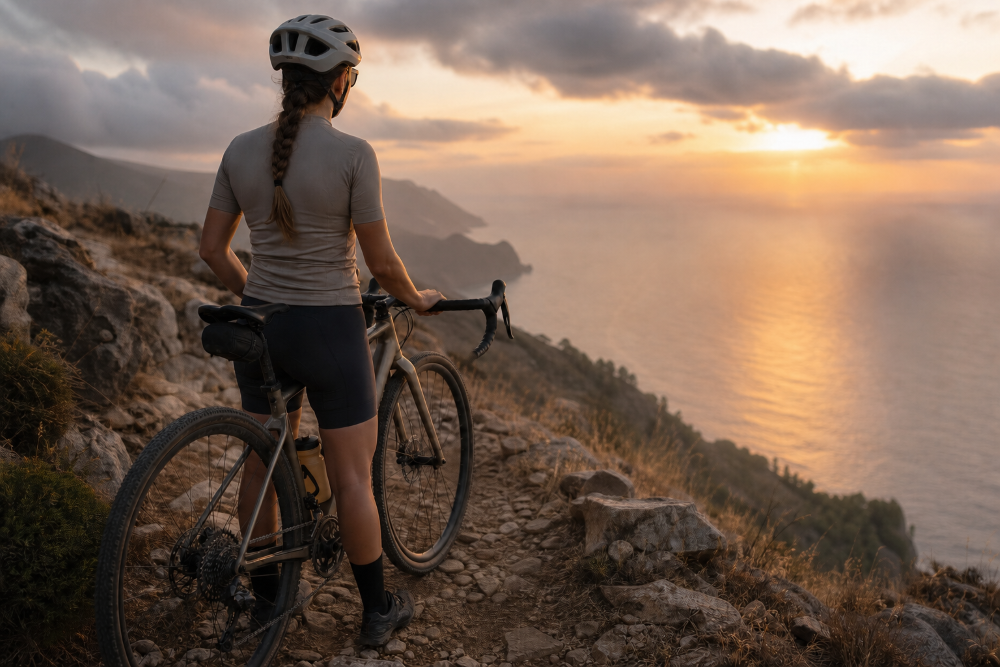
Gravel riding combines the speed and efficiency of road cycling with the adventure and freedom of off-road riding. You’re not hammering a criterium, and you’re not wrestling a full-suspension mountain bike through roots and rocks. You’re exploring farm tracks, forest roads, mountain passes, river valleys on a bike built to go almost anywhere.
And here’s the thing about gravel riding: it is extraordinarily inclusive. There is no pace requirement, no race bib needed, no pressure to keep up. The goal is simply to move through nature with your own power, on terrain that rewards curiosity more than speed.
For beginners, the appeal is immediate: less traffic than the road, less technical demand than mountain biking, and a very forgiving pace. For experienced cyclists looking to develop, gravel builds a specific set of fitness qualities: endurance, stability and power on varied terrain. These skills transfer beautifully across all cycling disciplines.
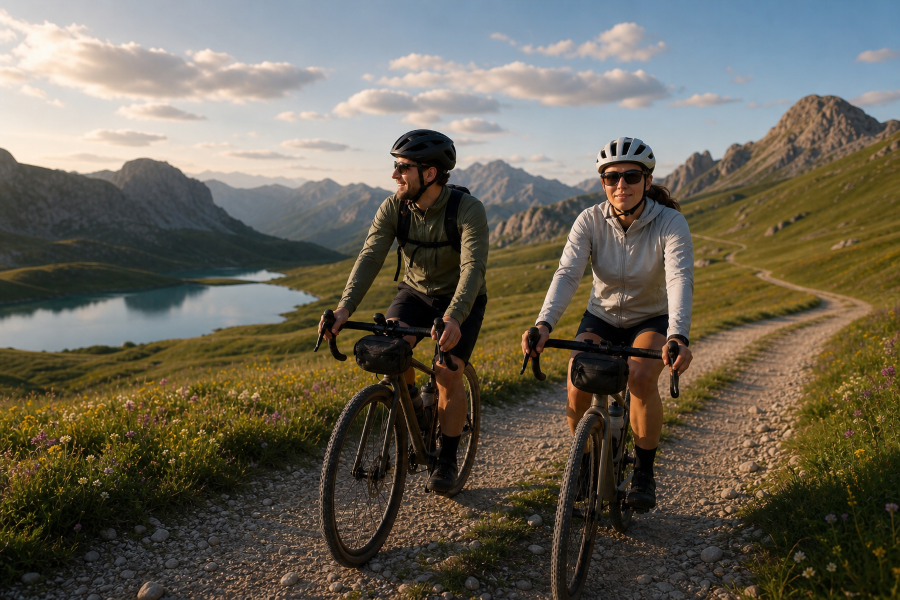
Gravel vs. mountain biking: what’s the difference?
Many cyclists come to gravel from mountain biking, or wonder which discipline suits them. They share a love of unpaved terrain, but the two sports are quite different in character, equipment, and fitness demands.
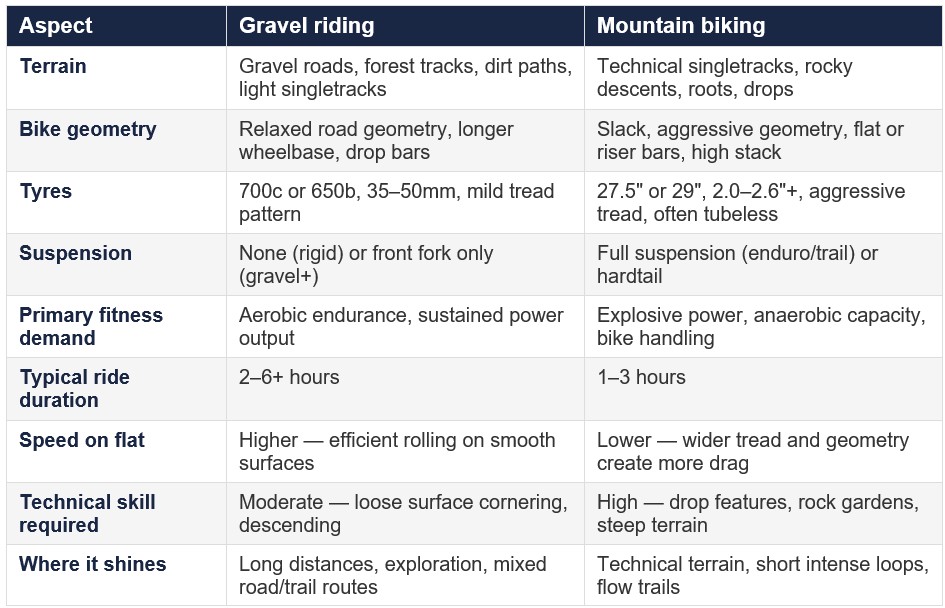
Neither is better — they serve different moods and different goals. But if your aim is to cover ground, explore the countryside, and build aerobic fitness in a sustainable way, gravel is a perfect match.
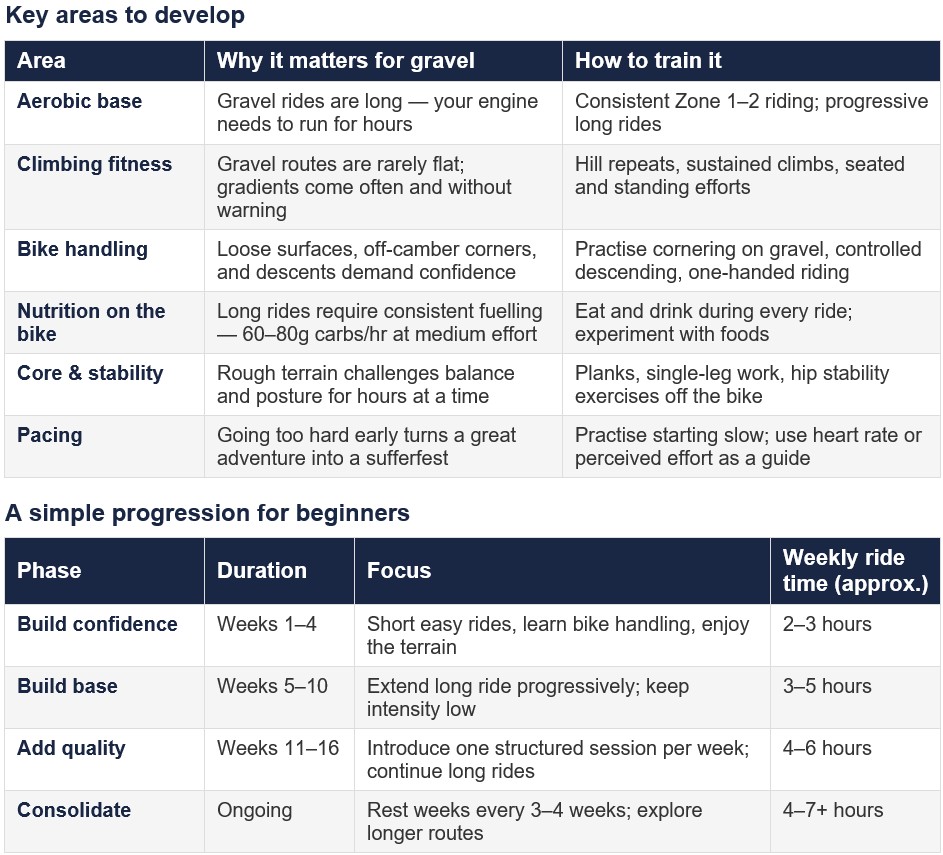
How to get better: training principles for gravel riders
The good news: you don’t need a complicated training programme to improve significantly as a gravel rider. A handful of consistent principles, applied regularly, will transform how you feel on the bike — and how far you can go before fatigue sets in.
The foundation: easy miles, most of the time
Roughly 80% of your riding should feel genuinely easy — conversational pace, heart rate in Zones 1–2. This is the cornerstone of the polarized training approach. Easy riding builds your aerobic engine, improves fat oxidation (critical for long rides), speeds up recovery, and allows you to absorb more training without breaking down.
The biggest mistake recreational riders make is riding everything at a vaguely moderate, medium-hard intensity — the ‘grey zone’ — which is too hard to recover well from, but too easy to drive meaningful adaptation. Go easier on your easy days. You will feel better, recover faster, and progress more.
“Go genuinely easy on easy days. Your aerobic engine is built in the quiet hours, not the hard ones.”
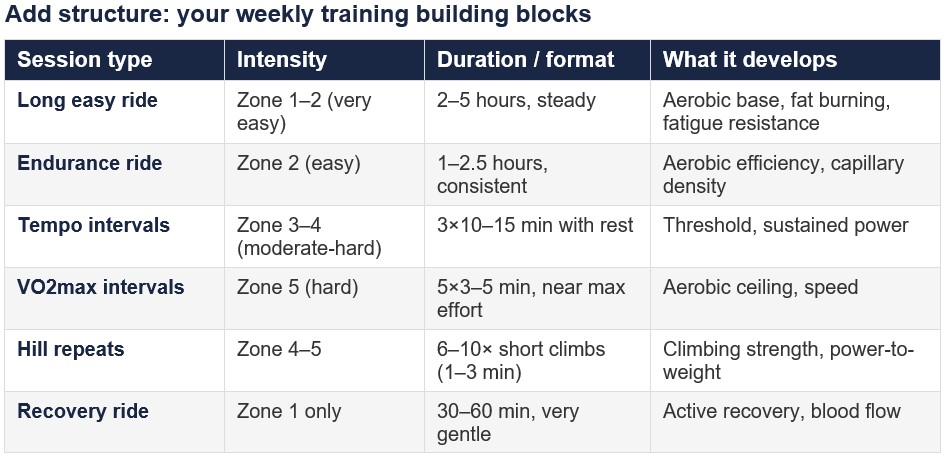
For a rider training 3–5 hours per week, a simple structure might look like: two easy/endurance rides, one longer weekend ride, and every second week one session with a short quality block (e.g. tempo intervals or hill repeats).
Out there, everything makes sense
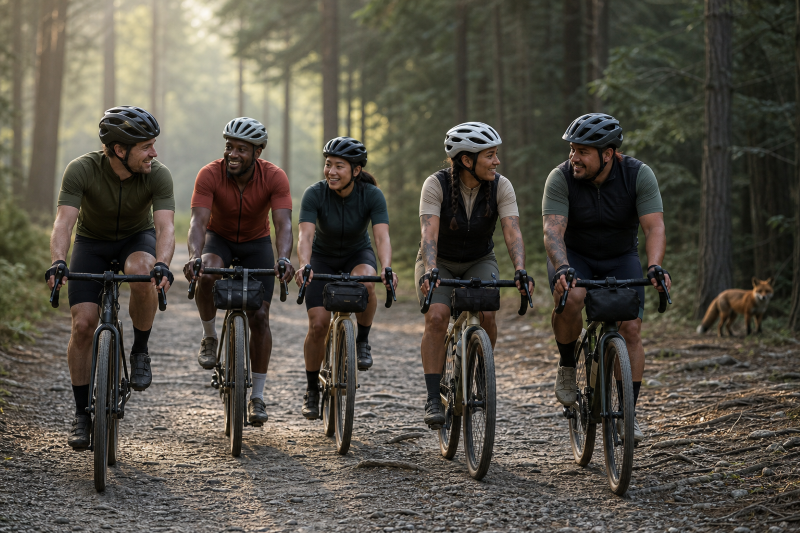
In the end, gravel riding isn’t about power numbers or average speeds. It’s about getting out there, exploring new roads and trails, and becoming stronger with every mile, both physically and mentally. Every ride builds something: endurance, confidence, technical skill, or simply the joy of moving through nature.
Start where you are today, ride consistently, and give your body time to adapt. The best gravel adventures rarely begin with ambitious goals; they start with the simple decision to head out and ride. So pump up your tires, choose a route you’ve never ridden before, and enjoy the freedom that comes with exploring on two wheels.
Main Sources (Selection)
- Seiler, S., & Tønnessen, E. (2009). Intervals, thresholds, and long slow distance: the role of intensity and duration in endurance training. Sportscience, 13, 32–53.
- Esteve-Lanao, J., Foster, C., Seiler, S., & Lucia, A. (2007). Impact of training intensity distribution on performance in endurance athletes. Journal of Strength and Conditioning Research, 21(3), 943–949.
- Jeukendrup, A. E. (2017). Periodized nutrition for athletes. Sports Medicine, 47(Suppl 1), 51–63.
- Laursen, P. B., & Jenkins, D. G. (2002). The scientific basis for high-intensity interval training. Sports Medicine, 32(1), 53–73.
- Maunder, E., Kilding, A. E., & Plews, D. J. (2018). Substrate metabolism during ironman triathlon: different horses on the same course. Sports Medicine, 48(10), 2219–2226.