Heat Adaptation in Endurance Sports: Why It Improves Your Performance and How to Train It Deliberately
Summer races, muggy training evenings, an Ironman under the blazing midday sun – heat is as much a part of endurance sport as headwind is part of cycling. While many athletes simply try to “survive” the heat, the body can actually be prepared for it in a deliberate way. Heat adaptation is one of the most effective and most underrated training tools available: it lowers the risk of heat-related problems, markedly improves performance in warm conditions, and even brings measurable benefits in cool weather. This article explains how it works physiologically and how to put it into practice.
Why Dissipate Heat at All?
Only around 20–25% of the energy your body produces during muscular work actually goes into forward motion. The rest is generated as heat and must continuously be dissipated through sweat evaporation, radiation, and skin blood flow. The hotter and more humid the environment, the harder this cooling mechanism becomes, and the higher your core body temperature rises at the same level of effort. This is exactly where heat adaptation comes in: it makes this cooling system more efficient.
The First Few Days: Plasma, Hematocrit, and Heart Rate
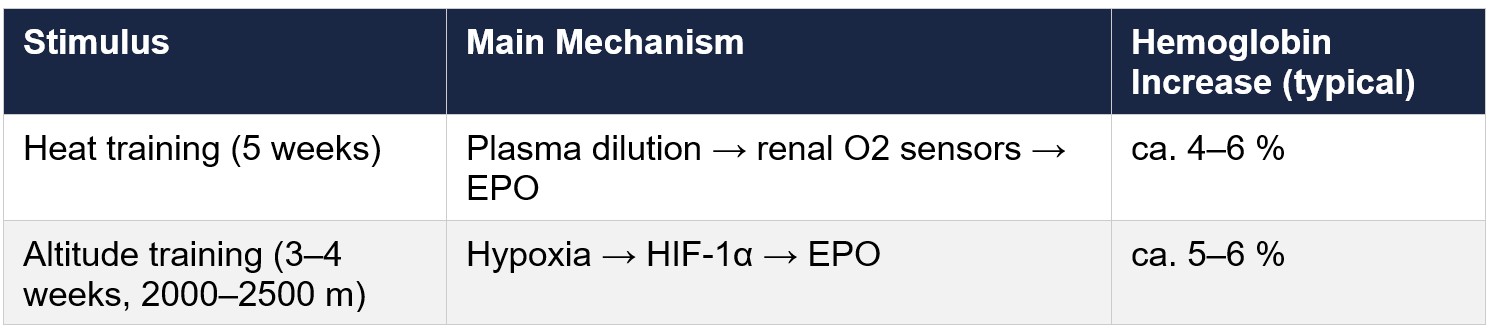
The fastest and most noticeable adaptation involves blood volume. After just 5–10 days of targeted heat training, blood plasma volume increases by roughly 5–10%. This dilutes the blood, and hematocrit temporarily drops. The kidneys detect this dilution via sensory mechanisms and begin producing more EPO, and with it more red blood cells.
This plasma expansion has a direct practical effect: the heart can pump more volume per beat (higher stroke volume), which can lower heart rate by around 10 beats per minute at the same workload. At the same time, perceived exertion rises less steeply, because core body temperature increases more slowly.
Over several weeks of continuous heat exposure, similar to altitude training, a genuine increase in hemoglobin mass also occurs. Studies show increases of about 4–6% for a 5-week heat protocol, comparable to classic altitude training (around 5%). The mechanism differs, however: altitude training works via oxygen deficiency, while heat training works via plasma dilution as the trigger for EPO stimulation.
Sweating Becomes More Efficient
As heat adaptation progresses, sweat quality also changes. The body learns to reabsorb more sodium in the sweat glands. Sweat becomes hypotonic (more dilute) and electrolyte loss per liter of sweat decreases, even as total sweat volume increases. The sweat glands also become more sensitive: they begin sweating earlier (a lower threshold for sweat onset) and produce more secretion per gland.
This earlier sweat response is part of an adaptation in the sympathetic nervous system: the sweating threshold drops, skin blood flow ramps up earlier and more strongly, while sympathetic vasoconstriction in the skin decreases. The body essentially learns to redirect blood from the internal organs to the skin more precisely and earlier, without meaningfully compromising muscle blood flow – a finely tuned balance between cooling and performance.
The Digestive Tract Is Protected
The digestive tract benefits too. Heat stress acutely reduces blood flow to the gut, which can make the gut barrier more permeable (leaky gut, a well-known problem in hot-weather competition). As adaptation progresses, blood flow regulation in the gut improves, and the intestinal lining becomes more resistant to this stress, partly thanks to heat shock proteins. This is one reason why heat-adapted athletes often tolerate their carbohydrate intake better during competition.
The Cellular Level: Heat Shock Proteins
After about a week of regular heat exposure, the body begins producing more heat shock proteins (HSPs). These act as molecular protectors: they stabilize and repair proteins that lose their folding under heat stress, thereby protecting cell structures from damage. Inflammatory responses are also dampened, and barrier functions, such as in the gut epithelium, are better preserved. These cellular mechanisms therefore lower the risk of heat-related organ damage, up to and including heat stroke, and substantially increase tolerance to heat.
How Quickly Is Adaptation Lost?
Heat adaptation is transient. The adaptations remain largely stable for about a week after training stops, after which decay sets in. After around three weeks without heat exposure, roughly 75% of the adaptations are lost again. As a rough rule of thumb, for every day without a heat stimulus, you lose the equivalent of about half a day’s worth of adaptation. So, an athlete who completes their last heat session three weeks before a hot-weather race will arrive at the start line barely adapted at all.
Practical Implementation: The Periodized Protocol
The biggest practical challenge is that heat training adds to recovery load, and in isolation, it reduces performance compared with the same training under cooler conditions. This is why the rule applies: complete the actual training session properly under normal conditions first, then add the heat stimulus afterward – for example with a sauna session after training. A well-documented approach is “post-exercise hot water immersion” or a sauna directly after the session, which triggers adaptations similar to active training in the heat, but without the additional orthopedic and muscular load.
For a classic 3–4 week protocol with daily or near-daily heat exposure (e.g., 12 sessions in 3 weeks, each 20–30 minutes of sauna after training), most of the thermoregulatory adaptation (heart rate, core temperature, sweat rate, plasma volume) already shows up within the first 7–10 days. Hemoglobin mass responds considerably more slowly, typically requiring 3–5 weeks of continuous heat exposure before a measurable increase occurs
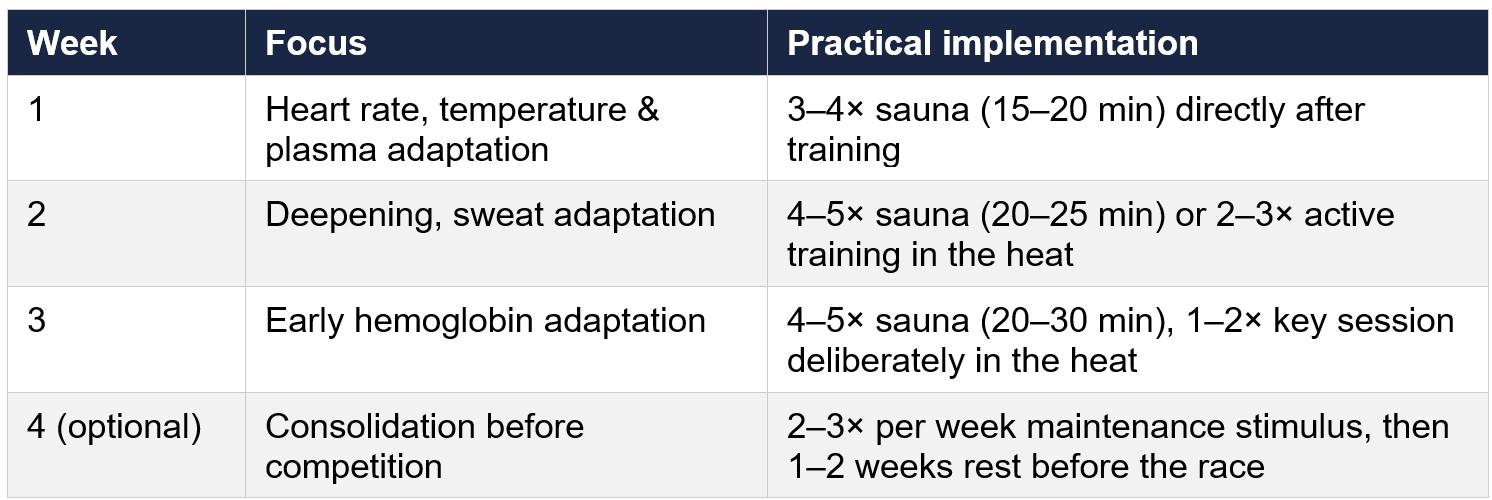
The protocol should be timed so that the last heat session falls about 5–10 days before the competition – close enough to still benefit from the adaptation, but with enough distance to be recovered at the start. Anyone who then maintains a short maintenance stimulus once or twice a week afterward can significantly slow the decay.
Conclusion
Heat adaptation is one of the most effective, and at the same time one of the most underrated, training measures in endurance sport. Within just a few days, blood plasma volume increases, easing the load on the heart and circulation. Over the following weeks, sweat regulation, temperature control, skin blood flow, and cellular protection via heat shock proteins all improve.
The result is a body that tolerates heat better, regulates its temperature more effectively, and works at a lower heart rate for the same output. The effort feels lower, and races held in warm conditions can be completed more successfully.
Planning your heat adaptation deliberately doesn’t require doing every session in the midday sun, nor does it mean sacrificing training quality. Just a few targeted heat sessions per week – for example through easy post-training exposure or regular sauna visits – are enough to trigger the key adaptations and arrive at the start line optimally prepared.
Main Sources (Selection)
- GSSI Sports Science Exchange (Sawka et al., based on Pandolf 1998) – heat acclimatization, thermoregulatory time course, and the ~75% decay after 3 weeks
- Rønnestad et al. (2021), Experimental Physiology – 5 weeks of heat training increases hemoglobin mass in elite cyclists
- Lundby et al., The Journal of Physiology – altitude vs. heat training for increasing hemoglobin mass and performance
- Périard et al. (2021) and related heat-training literature on plasma volume expansion over 10–14 day protocols
- Daanen et al. (2018) meta-analysis – heat acclimation decay and re-induction (cited via the PMC systematic review/meta-analysis on HA decay)
- Frontiers in Physiology (Zurawlew et al. / post-exercise hot water immersion study) – sauna/hot water immersion as a heat acclimation method and its retention
- CORE Body Temperature Help Center articles – applied summaries of heat vs. altitude training and combined protocols
- Precision Hydration – applied summary of heat training research (10-day cyclist study, plasma/stroke volume/VO2max changes)