Endurance Training Zones: What Happens in the Body – and Why Zone 2 Is So Important
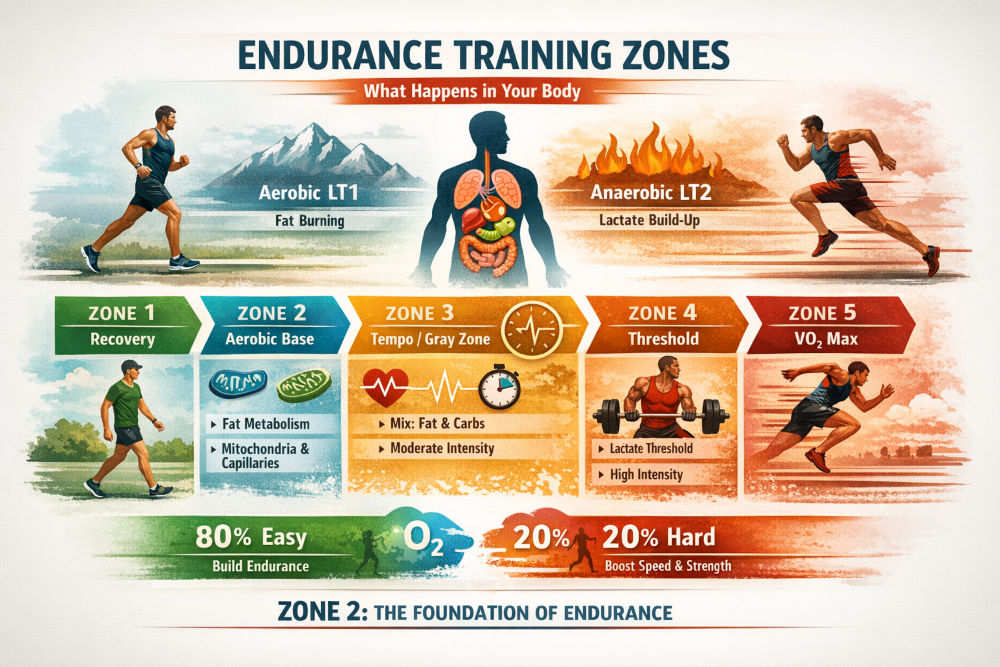
Anyone who gets into endurance training will sooner or later come across the term “training zones.” Behind it lies a core concept of training control: depending on intensity, different physiological processes take place in the body – and these ultimately determine how your endurance, speed, and even strength develop.
Here are the typical five training zones, with explanations of what happens in the body – and why Zones 1 and 2 should make up the majority of your training.
What are training zones?
Training zones divide exercise intensity into different ranges, usually based on heart rate or power output. Each zone corresponds to specific metabolic processes and physiological adaptations in the body.
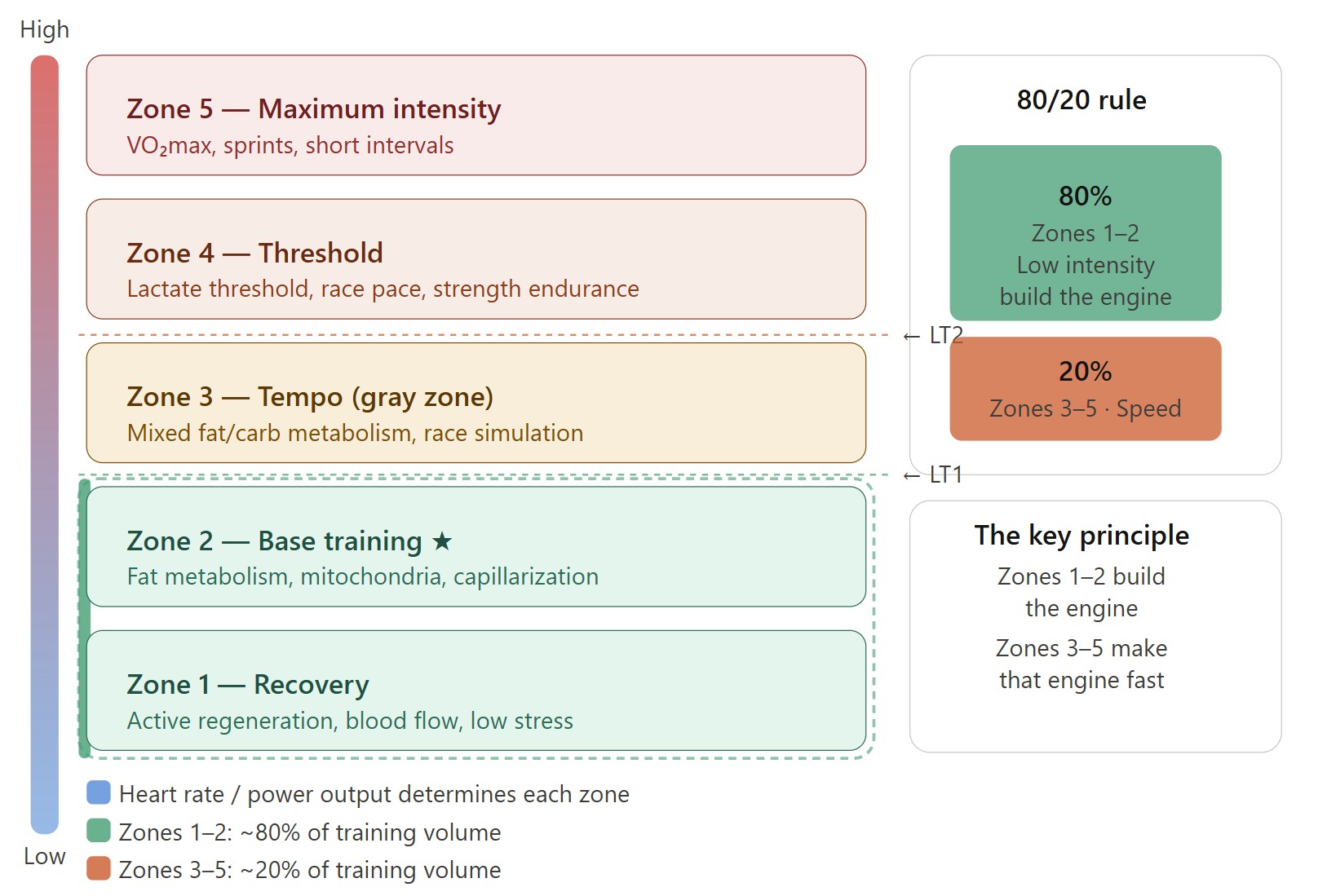
Fundamentally, everything revolves around two key physiological points:
-
- Aerobic threshold (LT1) – the point where lactate begins to rise slightly
- Anaerobic threshold (LT2) – the point where lactate rises rapidly and limits performance duration
Below these thresholds, your body works primarily aerobically (with oxygen); above them, it increasingly relies on anaerobic metabolism (without sufficient oxygen).
Zone 1: Recovery and active regeneration
Zone 1 represents the lowest intensity. You move very easily – walking, light cycling, or slow jogging.
Physiological effects:
-
- Improved blood circulation
- Removal of metabolic byproducts
- Minimal stress on muscles and the nervous system
Zone 1 primarily serves recovery and is essential for allowing your body to recover from harder sessions and remain capable of long-term performance.
Zone 2: The key to endurance
Zone 2 is the well-known “base training” zone. You train at an easy to moderate pace – one where you can still hold a conversation.
What happens in the body?
-
- Energy is mainly derived from fat metabolism
- Development and improvement of mitochondria (energy production)
- Increased capillarization (better oxygen delivery to muscles)
- A more efficient cardiovascular system
These adaptations allow your body to produce energy more efficiently and sustain effort for longer.
Why so much Zone 2?
Most successful training models emphasize low intensity. In the so-called polarized model, a large portion of training takes place in Zones 1–2.
The reasons:
-
- You can accumulate high training volume without excessive fatigue
- The aerobic base is built sustainably
- Higher intensities rely on this aerobic foundation
In short: Zone 2 is the foundation of endurance performance.
Zone 3: The “gray zone” (tempo)
Zone 3 is more intense – often described as a steady, moderately hard effort.
Physiological effects:
-
- Mix of fat and carbohydrate metabolism
- Improvement of aerobic performance
- Preparation for longer competitions
This zone is often considered a “gray zone”: too hard for recovery, but not intense enough for maximal adaptation.
However, it still has its place, especially for:
-
- Tempo runs
- Longer race simulations
Zone 4: Threshold training
Zone 4 lies around the anaerobic threshold – here the effort becomes significantly challenging.
What happens in the body?
-
- Strong reliance on carbohydrates as fuel
- Increased lactate production
- Training the ability to tolerate and clear lactate
Benefits:
-
- Improved lactate threshold
- Higher sustainable race pace
- Development of strength endurance
This zone is crucial for performance gains, but also demanding, so it must be used strategically.
Zone 5: Maximum intensity and VO₂max
Zone 5 is the highest intensity – short, hard, and demanding.
Physiological effects:
-
- Maximum activation of the anaerobic energy system
- Improvement of VO₂max (maximum oxygen uptake)
- Training of speed and explosiveness
This zone includes:
-
- Sprints
- Short intervals
- High-intensity efforts
The duration is short because the body can only sustain this level of effort briefly.
Why Zones 1 and 2 should dominate
Many recreational athletes make the mistake of training too often at a moderate intensity. However, training data and real-world practice show:
Successful endurance athletes often follow the 80/20 principle:
-
- ~80% low intensity (Zones 1–2)
- ~20% high intensity (Zones 3–5)
Why?
- Volume beats intensity (in the long term)
Lower intensity allows for more total training time and stronger adaptations. - Lower injury risk
The body is under less stress. - Stronger aerobic base
Without this foundation, hard sessions are less effective. - Better recovery
You can train more frequently.
Why the other zones still matter
As important as Zones 1 and 2 are, higher intensities provide essential stimuli:
-
- Zone 3: improves tempo efficiency
- Zone 4: raises the lactate threshold
- Zone 5: increases maximum performance and speed
Or simply put:
Zones 1–2 build the engine.
Zones 3–5 make that engine fast.
Conclusion
Endurance training is more than just “running a lot” or “training hard.” The targeted use of training zones allows you to develop your body optimally.
- Zones 1–2: foundation, efficiency, endurance
- Zone 3: transition and tempo
- Zone 4: pushing performance limits
- Zone 5: maximum performance and speed
The key is to combine these zones in the right proportions. Anyone who wants to improve long-term should keep most of their training easy – and use high-intensity sessions strategically.
Sources (selection)
- Vogt M. et al., Swiss Olympic / mobilesport.ch (2005) – physiological training zones, definition of aerobic and anaerobic thresholds
- Bandana Training (n.d.) – lactate threshold (LT1, LT2) and relation between heart rate and metabolic stress
- Grauvogl A., Merkur.de (2024) – heart rate zones and relationship between intensity, fat, and carbohydrate metabolism
- Run Tri Bike Magazine (2025) – physiological adaptations from Zone 2 training (mitochondria, capillaries, cardiac output)
- DBA Online (Hottenrott K.) (2025) – training models (polarized, pyramidal) and intensity distribution in endurance training
- Run Analytics Zone (2025) – 80/20 principle and importance of intensity distribution